Unveiling the Chemical and Stain Resistant Properties of Garage Floor Coating

evaporate;The garage floor is often an underrated space. It’s not displayed in the living room or involved in family social interactions, yet it silently endures the most complex and frequent chemical challenges: the slow, dark stains of engine oil, the instant spread of brake fluid from a careless drip; the pungent odor left by cleaning solvents before they evaporate, and the repeated exposure to coolant, fuel, and de-icing salt throughout the changing seasons.
Only when these scenes occur repeatedly do people begin to realize… Garage floor coating is not just a matter of “looks good or bad,” but a long-term battle about chemical resistance, water penetration resistance, and stain resistance.
The truly valuable discussion is not about whether a particular coating is “hard enough,” but rather about what happens to different types of coatings in a real garage environment when faced with oil, automotive liquids, and solvents.
A chemicalChemical attack is not a one-time event but a long-term consumption.
Many discussions about garage flooring tend to focus on “wear resistance” or “load-bearing capacity.” However, from a practical perspective, what truly causes flooring to age, discolor, or even fail is often not weight, but continuous contact with chemical substances. This is precisely where the real value of a Garage Floor Coating begins to emerge.
Engine oil, transmission fluid, and brake fluid are not just “liquids.”
They contain solvents, additives, and acidic or alkaline components that can react with the ground at a microscopic level. Without a properly formulated Garage Floor Coating, these substances do more than stain—they penetrate.
On untreated or insufficiently protected concrete surfaces, these chemicals can quickly seep through capillary pores, creating deep-seated contamination. At first, the impact may appear limited to surface darkening. Within months, however, the damage often becomes embedded and resistant to routine surface cleaning.
This is why more garages are shifting their attention toward chemical-resistant Garage Floor Coating systems—not for extreme industrial use, but to withstand daily, repeated, and unavoidable chemical exposure that defines real-world garage environments.
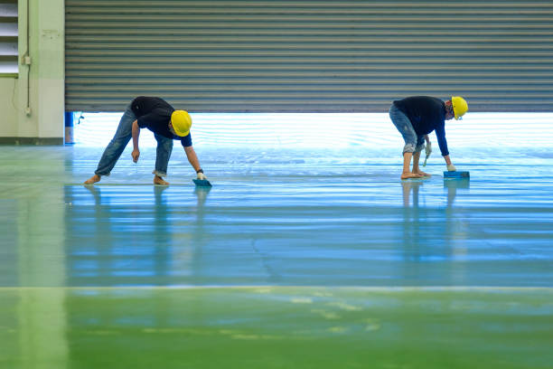
Differences in protection logic between different Garage Floor Coatings
Floor coatings that may appear similar on the surface are actually completely different in terms of their chemical protection mechanisms.
A protection strategy centered on enclosure.
Some garage floor coatings liesome Garage Floor Coatings lies in forming a highly dense surface film. These coatings emphasize “barrier”—keeping oil and liquids on the surface rather than penetrating the floor.
When engine oil drips, it’s more likely to remain on the glass than be absorbed. This is a common experience mentioned in user feedback:
“The oil can be wiped off, but it doesn’t leave a shadow.”
This protective method is particularly evident in oil stain protection coating scenarios.
The key is not how thick the coating itself is, but whether it truly seals the microporous structure of the concrete.
Chemical stability-oriented tolerance mechanisms
decomposed,Another type of coating focuses on “coexistence” rather than complete isolation.
They have a higher tolerance to acids, alkalis, and solvents in their molecular structure and are not easily softened, decomposed or discolored even in short-term contact.
This type of garage floor coating has a more significant advantage when dealing with automotive fluids containing additives, such as brake fluid and coolant. Even if not cleaned promptly, the surface structure is less prone to change. This point has been repeatedly mentioned in long-term user feedback:
“It’s not that it hasn’t spilled, but rather that it hasn’t left any residue.”
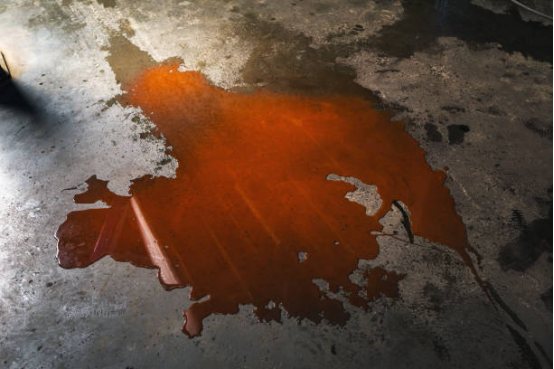
The actual differences in the properties of three types of liquid solvents in oily cars
Grouping all “dirt” into a single category often obscures the true nature of the problem. Different chemical substances pose very different challenges to a Garage Floor Coating, and treating them as equivalent leads to misjudgment.
Slow penetration of oil stains
Engine oil and lubricating oil are characterized by high viscosity, slow penetration, and continuous action.
They rarely cause immediate damage; instead, they interact with the floor surface gradually over extended periods.
On poorly protected floors lacking an effective Garage Floor Coating, oil stains are most likely to form so-called “shadow stains”—the surface may appear clean, but the underlying color has already undergone irreversible change.
On well-sealed Garage Floor Coating systems, oil residues tend to remain more “cleanable,” making the effectiveness of routine cleaning the decisive factor rather than permanent damage.
Chemical complexity of automotive fluids
The challenge posed by brake fluid, coolant, and power steering fluid lies in their complex chemical formulations.
These fluids often contain components that are hostile to ordinary surfaces, easily causing stickiness, loss of gloss, or even minor corrosive effects.
In this context, chemical-resistant Garage Floor Coating is no longer an abstract concept.
Coatings with insufficient chemical tolerance may exhibit localized surface changes after only a few exposures, whereas a well-engineered Garage Floor Coating can maintain structural and visual stability under repeated contact.
Instant destructive power of solvents
Cleaning agents, degreasers, and certain solvents can be summarized in one word: fast.
They are capable of completing chemical reactions within minutes, sometimes seconds.
A common misconception is that “occasional use won’t matter.” In reality, even a single improper application can cause localized failure in a Garage Floor Coating.
This is why professional garage maintenance guidelines consistently stress the importance of solvent testing and coating compatibility checks before use.
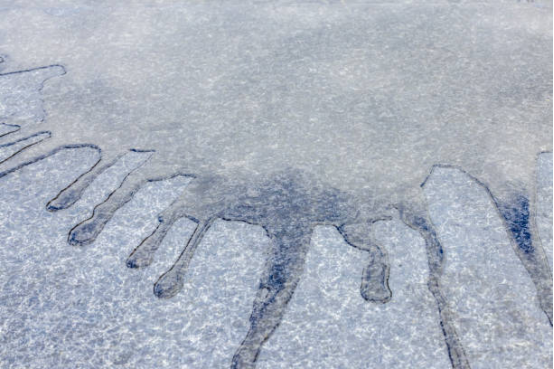
The Practical Significance of Garage Spill Prevention
Many people understand garage spill prevention as “reducing spills.”
But from the perspective of ground systems, it is more like a consequence management capability.
In reality, spills cannot be completely avoided. What truly differentiates us is how ground systems respond to situations that have already occurred.
Excellent garage floor coating cannot prevent accidents, but it can keep them within a “recoverable” range.
Oil stains will not become permanent marks, liquids will not leave unpleasant odors, and cleaning will not become one deep-sanding session after another.
flooring.”This is why more and more users are shifting their focus from “decorative flooring” to “functional flooring”.
The implicit judgment criteria behind user experience
TrulyAmong numerous user reviews, an interesting phenomenon has repeatedly emerged:
truly recognized coatings are rarely described as “very durable,” but rather as “worry-free.”
What does peace of mind mean?
It means not having to worry about whether each maintenance will damage the surface;
it means that when a splash occurs, the first reaction is to grab a rag, not to panic.
It means that years later, the floor will still be in the same condition.
Understanding stain resistance is more important than memorizing the name.
There are countless names, classifications, and terms for garage floor coatings on the market, but for users, the most important thing is not to remember these labels but to understand the protection logic behind them.
Does it combat contamination through barrier treatment
or through chemical stability?
Which threat is more frequent in your operating environment?
Once these issues are clarified, the chemical resistance and stain resistance of the ground will no longer be vague concepts but rather predictable and manageable performance characteristics.
Returning to the initial scene
Engine oil dripped onto the ground again.
This time, it didn’t spread or leave a shadow; it just stayed there, waiting to be wiped away.
Perhaps this is the true meaning of chemical resistance and stain resistance—
not to make the garage “perfect,” but to prevent everyday mistakes from becoming a long-term burden.
The next time you walk into your garage and see a clean, stable floor, consider this:
It endures far more than you see.


