Garage Floor Coating: Comprehensive Chemical Tolerance Test

Table of Contents
For most people, a garage floor is just a place to park. But for us true car enthusiasts and mechanics, a garage floor is more like a giant chemistry lab bench.
out, andHere, gravity is always merciless. No matter how careful you are, that bottle of 5W-30 engine oil will eventually slip out, gasoline will always splash out when you refuel your lawnmower, not to mention that when you change your brake calipers, that drop of highly corrosive brake fluid will silently drip onto the ground.
If you’re using regular DIY garage floor paint, the countdown begins now: you have about 5 minutes to wipe it off, or it will bubble, peel, and reveal the ugly concrete.
But if you’re using a professional industrial-grade garage floor coating, the story ends very differently. Today, we’ll strip away the marketing hype and put on a lab coat to delve into the real-world performance of epoxy flooring‘s chemical resistance, seeing who emerges victorious when facing the “chemical reaper” of your garage.
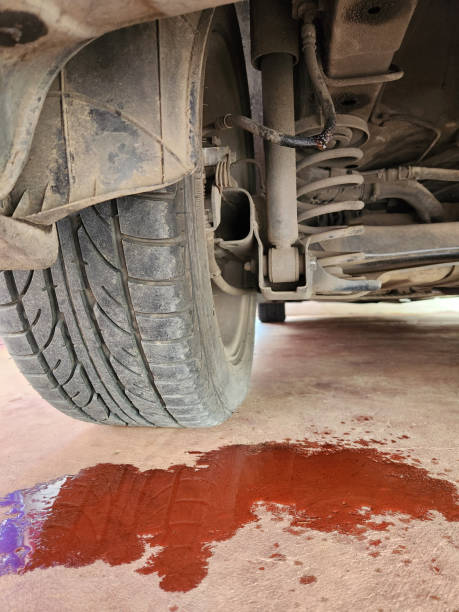
The Corrosive Truth About Brake Fluid
killer.”Of all the fluids commonly found in garages, brake fluid (especially DOT 3 and DOT 4) is an absolute “floor killer”.
Why? Because the main component of brake fluid is ethylene glycol ethers. In the chemical world, this is an extremely effective solvent. In fact, it is the main component of many old-fashioned paint strippers. It works by penetrating between polymer chains, breaking the bonds between molecules, causing the coating to soften, wrinkle, and eventually peel off like dead skin.
Scenario Test: Brake Fluid on Garage Floor
| Category | Type of Coating | Result |
|---|---|---|
| Competitors | Common single-component acrylic latex paints or water-based epoxy paints. | Disastrous. Once brake fluid comes into contact with the surface, you’ll see the paint start to bubble within 15-30 minutes. When you try to wipe it with a cloth, you’ll wipe away the paint along with it, exposing the bare concrete underneath. |
| Hero | 100% solids content epoxy resin or polyaspartic ester. | Due to its extremely high cross-linking density, this polymer structure forms a dense network. Large brake fluid molecules have difficulty penetrating it. In the standard ASTM D-1308 test, a high-quality coating can withstand immersion in brake fluid for 24 hours or longer, with only slight softening or a decrease in gloss, but never peeling. |
an “it’llExpert opinion: Even the best coating isn’t completely immune to brake fluid. What it buys you is “time.” It transforms what could have been an “immediate damage” crisis into a “it’ll be fine to clean it up tomorrow morning” situation.
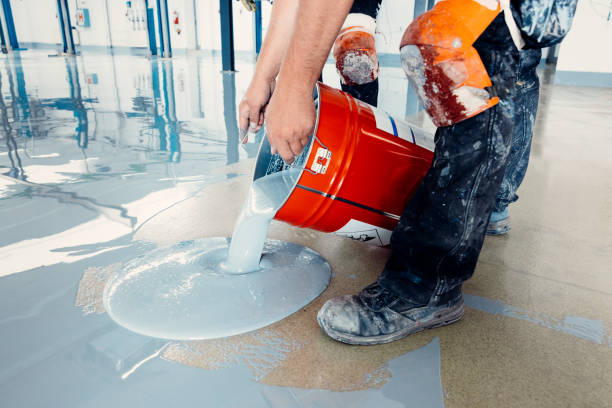
-ResistantStandard Gasoline Resistant Floor Paint
The threat posed by gasoline differs from that of brake fluid. Gasoline is a highly volatile mixture of organic solvents containing aromatic hydrocarbons such as benzene, ethylbenzene, and toluene. For inferior floor paints, gasoline acts like a strong acid, rapidly dissolving the resin binders within the paint film.
“swelling.”When you look for gasoline-resistant floor paint, you are actually looking for a material that can resist “swelling“.
| Type | Behavior with Gasoline |
|---|---|
| Ordinary paint | When gasoline is spilled, the paint film quickly absorbs the solvent and expands. When the gasoline evaporates, the paint film shrinks and cracks, leaving permanent scars. |
| Professional Coating | In the garage floor coating durability test, industrial-grade flooring exhibited remarkable inertia when splashed with gasoline. Even after the gasoline evaporated and dried naturally on the floor, it could usually be restored to its original condition with simple soapy water washing. |
issue,Note: Although the structure will not be damaged, prolonged (more than 24 hours) gasoline buildup may cause some epoxy resin surfaces to “yellow” or be slightly stained, but this is purely an aesthetic issue and the protective layer remains intact.
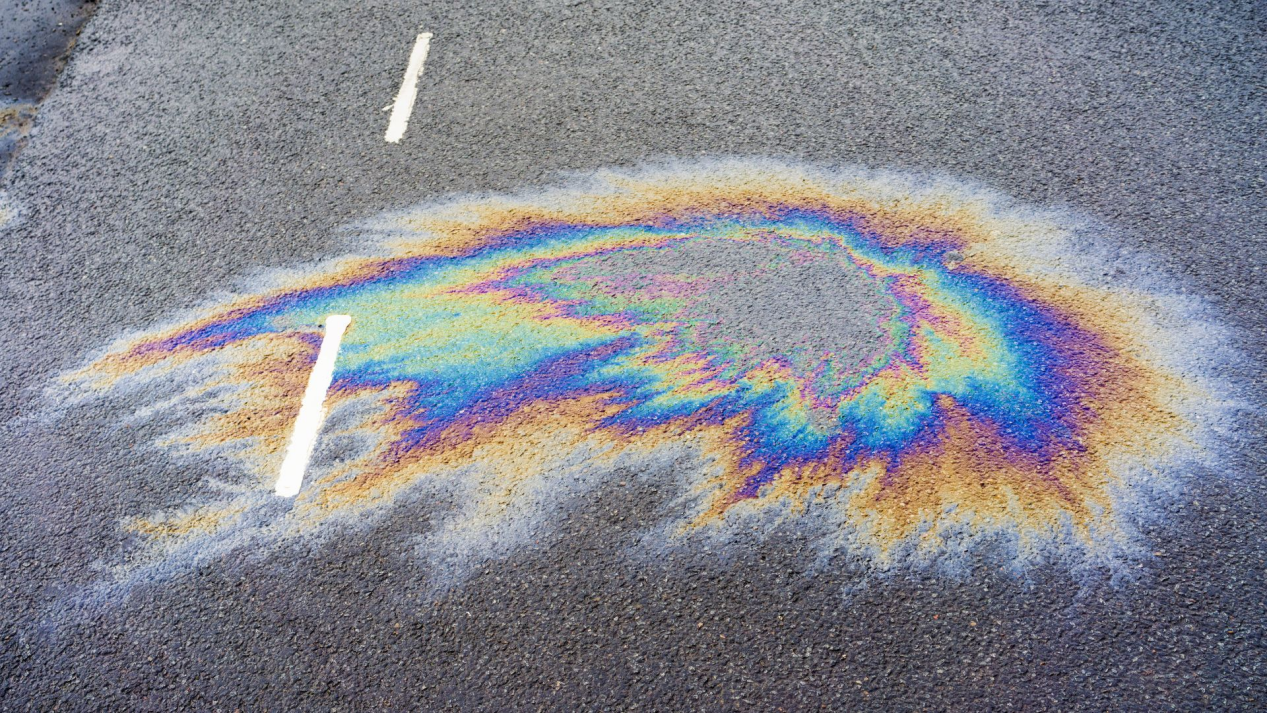
Engine oil, antifreeze and road salt
If brake fluid is the assassin, then engine oil, antifreeze, and road salt are the infantry fighting a protracted war.
Hot Motor Oil
Cold engine oil is just dirty, but hot engine oil (which can reach temperatures as high as 100°C) dripping from an engine that has just been turned off is penetrating.
Exposed concrete: Concrete is a porous sponge. Hot engine oil can instantly penetrate deep into the pores, forming permanent black stains that no cleaning agent can completely remove.
Garage Floor Coating: The coating seals all pores. Hot oil simply stays on the surface and cools. Whether it stays on for a week or a month, you can wipe it clean with just a paper towel, and the floor underneath will still be sparkling clean.
Road Salts & Brine
For car owners in northern regions, the de-icing slurry brought into the garage in winter is a nightmare for concrete.
pit.When salt water seeps into concrete, the water evaporates and the salt crystallizes and expands, generating enormous internal pressure that causes the concrete surface to spall and pitting.
The high-quality coating completely blocks the path of salt contact with the concrete through physical isolation. It’s like putting a permanent Gore-Tex jacket on your garage floor.
Why is “surface damage” acceptable?
When discussing the chemical resistance of epoxy flooring, we need to establish a correct concept: the coating is meant to be sacrificed, and the concrete is meant to be preserved.
Many customers get frustrated when they find a small spot on their coated surface due to prolonged contact with battery acid. But as an industry expert, I would congratulate them.
Why? Because if that spot appears on the coating, it means the coating has successfully blocked the acid. Without this garage floor coating, that drop of acid would already be corroding your house’s foundation, causing irreversible structural damage.
A professional coating system is designed as a robust defense against chemical attacks, physical abrasion, and UV radiation. It may bear the marks of years of “chemical warfare,” but it ensures that your asset—the concrete substrate—remains in perfect condition as it was on the day of pouring.
Conclusion
When purchasing garage flooring materials, don’t just look at how pretty the color is on the color swatch. You need to ask your contractor or check the Chemical Resistance Chart in the product manual.
Look for products that explicitly state they are resistant to brake fluid, gasoline, and Skydrol (aviation hydraulic fluid). Because in a garage, a space fraught with uncertainty, you’re not just buying flooring; you’re buying insurance against accidental spills.
As the next drop of brake fluid falls, you can calmly finish your coffee before grabbing a rag. That’s the confidence that professional-grade garage floor coating brings.
FAQ
Q1: If brake fluid drips onto my garage floor coating, how long will it take me to clean it up?
This depends on the type of coating. For regular DIY water-based epoxy, you’ll need to clean it immediately (within minutes). For professional 100% solids epoxy or polyaspartic ester, there’s usually a 24-hour safety window. Cleaning within this time will leave no marks on the surface. If more than 24 hours have passed, a slight haze or dulling of the gloss may occur, but the coating won’t peel.
Q2: Will gasoline dissolve my floor paint? (Is gasoline-resistant floor paint really invincible?)
High-quality industrial coatings are highly gasoline-resistant and will not dissolve. However, some high-octane gasoline with added ethanol, if left on the surface for an extended period (several days), may cause yellowish-brown stains on light-colored floors. This is surface staining and does not affect the physical protective properties of the coating.
Q3: Since the coating can protect against chemicals, why is it necessary to conduct a durability test?
Chemical resistance is only one part of the garage floor coating durability test. Durability testing also includes abrasion resistance, impact resistance, and hardness. A good floor must be an all-rounder: it must resist the chemical corrosion of brake fluid and withstand the physical pressure of a jack. Focusing on only one indicator is the biggest misconception when choosing a flooring.


