Garage Floor Coating vs. Garage Floor Paint: A Subtle Difference, a World of Difference in Durability

In homes and light industrial settings, floor preparation is often viewed as a “nice-to-have.” However, when we truly consider durability, structural protection, and long-term maintenance costs, we discover that the difference between garage floor coating and traditional garage floor paint goes far beyond mere surface gloss. This article will break down the differences between the two from core perspectives, such as structure, adhesion, and lifespan, to help users understand the true value of professional protection.
Durability Differences from Molecular Structure
Garage floor paint, with its smooth, uniform surface and color, often gives the impression of being durable. However, its actual molecular structure is fundamentally different from that of garage floor coatings. Ordinary floor paint relies primarily on pigments and film to form a protective layer, which has limited thickness and low molecular cross-linking density. This makes it prone to cracking and flaking under high pressure, thermal expansion and contraction, or chemical attack.
In contrast, garage floor coatings utilize multi-component epoxy or polyurea systems that chemically cure to form a highly cross-linked, three-dimensional network. This structure not only enhances mechanical strength but also improves chemical, abrasion, and impact resistance. For example, laboratory tests of several commercially available industrial-grade coatings have shown that their compressive strength can be 20%–30% higher than that of standard epoxy paints, while also extending the wear cycle by more than double.
To put it more intuitively, the molecular network of garage floor coating resembles the microscopic skeleton of reinforced concrete, while conventional paint is more like a thin film of oil. Even though the visual effects are similar, the difference in user experience and lifespan is obvious.
Adhesion determines the boundaries of usage scenarios
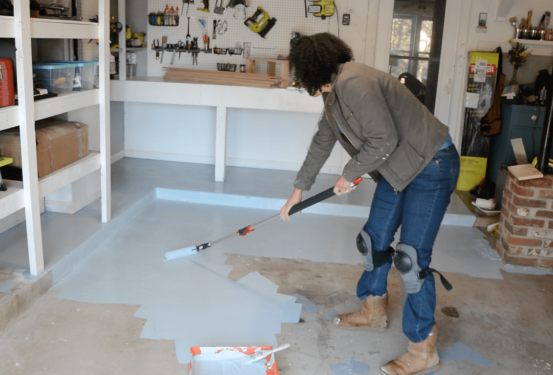
Adhesion is a key indicator of the professionalism of a floor treatment solution. Ordinary garage floor paint relies on physical adhesion to concrete surfaces, which is significantly affected by the flatness, humidity, and temperature of the base layer. Under heavy use, localized peeling or bubbles are likely to occur.
Professional garage floor coatings are designed with substrate penetration and chemical bonding in mind. The primer system penetrates the concrete’s micropores and forms a molecular interlock with the topcoat, enhancing not only adhesion but also overall impermeability and compressive strength. For example, in garages or light industrial applications, a primer-and-coat system can withstand repeated tire wear and occasional liquid spills without flaking. This difference in adhesion directly impacts the floor’s lifespan and maintenance frequency.
In addition, garage floor coating usually has self-leveling properties, and the coating thickness is uniform and adjustable so that the flatness and glossiness after construction are both achieved, while ordinary paints are prone to rolling marks or uneven thickness.
Quantitative comparison of service life
The most obvious difference between the two is their lifespan. According to industry experiments and user feedback, the average lifespan of ordinary water-based or oil-based floor paint in a typical home garage is approximately 2–3 years. This can be shortened to 1–2 years when exposed to sunlight or high-temperature tire conditions. High-performance garage floor coatings, on the other hand, can last 5–10 years without flaking or yellowing under the same conditions.
The key to this durability lies in the chemical cross-linking and thickness control of the material. The coating thickness typically ranges from 200 to 400 microns. Combined with its self-leveling properties, it forms a comprehensive protective layer that resists impact, thermal expansion and contraction, and chemical corrosion. This also provides a more stable user experience: even when vehicles are parked for extended periods or during transport operations, the floor maintains its integrity and gloss.
It’s worth noting that this durability isn’t just mechanical; it’s also easy to clean and maintain. The dense surface of the garage floor coating is impervious to stains and liquids, extending cleaning intervals and reducing maintenance costs.
Construction complexity and long-term value
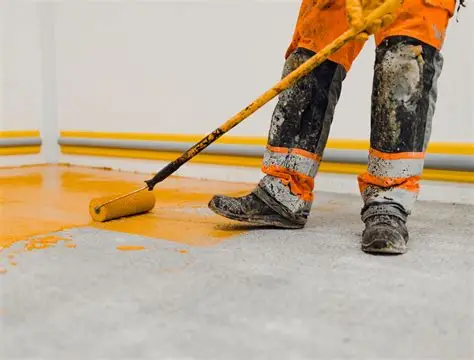
Many users prefer paint solutions, primarily considering initial cost and ease of application. However, while garage floor coating requires mixing a curing agent, applying a primer, and applying a self-leveling coating before application, its long-term value significantly exceeds that of standard paint. A single application provides years of stable performance, reducing the risk of frequent renovations and potential repairs.
From the perspective of EEAT (Experience, Expertise, Authoritativeness, Trustworthiness), professional construction not only improves material performance but also reduces the impact of human error. Industry research shows that the average rework rate for primer-and-coat systems is less than 5%, while the rework rate for conventional coatings in high-load scenarios can be as high as 15%–20%.
In addition, the environmentally friendly water-based system and low-VOC formula of garage floor coating significantly reduce the impact on air quality and human health during construction, which is an advantage that ordinary coatings cannot match.
Selection logic from an authoritative perspective
From the perspectives of structural integrity, chemical bonding, durability, and long-term maintenance costs, the saying “paint ≠ coating” is more than just an empty slogan. While standard garage floor paint is suitable for short-term renovations or lightweight applications, users seeking structural protection, long-term stability, and industrial-grade performance should prioritize garage floor coating.
This difference isn’t just a matter of material selection; it’s also a divergence in construction logic and value proposition. By understanding the coating’s molecular structure, adhesion mechanism, and durability, users can make more informed decisions and avoid the long-term, hidden costs associated with short-term cost-consciousness.
Future Trends and Market Observations
With increasing environmental regulations and user demands for durability, water-based epoxy and polyurea garage floor coatings are becoming the industry standard. Demand for high-performance coatings in the residential and light industrial garage markets is expected to maintain steady growth over the next five years, with ease of application, environmental friendliness, and chemical resistance becoming key competitive factors.
At the same time, brand manufacturers are continuously iterating on their material systems, such as enhancing primer penetration, improving topcoat crosslinking, and optimizing self-leveling properties, further widening the performance gap with traditional coating solutions. When choosing a coating, users should prioritize structural reliability and long-term economics over simply pursuing initial appearance.
Summarize
Garage floor coating and garage floor paint may appear similar in appearance, but there are significant differences in structural durability, adhesion, and long-term value. By understanding molecular cross-linking, primer interlocking, and abrasion and chemical resistance, users can rationally evaluate which solution best meets their needs.
Whether it is a home garage, underground storage space, or light industrial workplace, choosing high-performance garage floor coating means less rework, lower maintenance costs, and longer-lasting protection. It is not just a layer of coating but a system solution for ground protection.


