Aesthetic Evolution: Color and Texture Trends in Garage Floor Coating

Garage floors were once synonymous with practical spaces—gray, concrete, and functional above all else. Today, with the evolution of home design, garage floor coating has evolved from a protective layer to a component of visual expression. No longer simply serving the purpose of wear resistance and slip resistance, it has become a key element of a home’s aesthetic, a discreet space that showcases elegance.
Over the past five years, the color trend of garage coatings, like interior design, has undergone an “aesthetic revolution from the inside out.” People have begun to pursue color layers, the real touch of materials, and even the fluidity of gloss—these details are exactly what high-end users are most sensitive to.
Grayscale is firmly established in the world of garage floor coatings. Unlike earlier bright grays or bluish-grays, today’s trends are trending toward desaturated cool grays, warm grays, and even graphite black . This color has an architectural quality that blends naturally with modern, minimalist, or industrial-inspired garage spaces.
Designers often recommend creating a contrasting color palette between the floor and the walls or storage systems. For example, a light gray floor with dark storage cabinets can create a sense of depth, while a dark gray floor with light walls creates a sense of visual envelopment.
Interestingly, the American Institute of Design’s 2024 trend report notes that more and more homeowners are choosing colors like “Dusty Concrete” and “Matte Steel” for garage floor coatings. These colors conceal stains while maintaining a soft play of light and shadow. These colors aren’t designed to “please” but rather to “settlement” the space’s atmosphere.
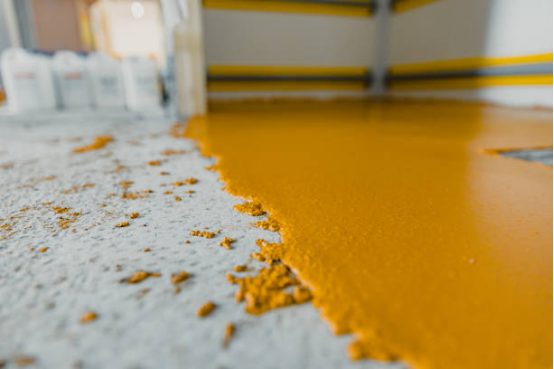
Metallic particles and glossy layers: when functionality meets luxury
Metallic particles are no longer exclusive to showrooms. Today’s garage floor coatings utilize nano-reflective technology to create subtle variations in reflectivity under varying light sources—resembling liquid metal or deep-sea light.
This trend is no accident. With the increasing popularity of high-end vehicles, garages are becoming “living spaces.” Many owners desire garages to function not just as parking spaces but as mini galleries. In this context, the value of metallic coatings goes beyond aesthetics to become a lifestyle statement.
Three types are particularly popular:
- Silver Mica Flakes : They exhibit delicate reflections under natural light and have a very modern temperament.
- Copper Glitter : Often used in retro or industrial style spaces, it appears more profound when paired with warm lighting.
- Pearl Finish : Used to create a clean, minimalist but not cold visual experience.
It is worth noting that high-quality garage floor coatings, while adding these metal particles, still maintain the safety standard of anti-slip coefficient (usually ASTM C1028 ≥ 0.6), which means that aesthetics and safety are not in conflict.
Matte and micro-texture: the evolution of touch
Beauty isn’t just visible; it can also be felt underfoot. The popularity of matte finishes reflects the company’s move toward a more humane touch in garage floor coatings.
While traditional high-gloss floors are bright and beautiful, they are prone to slipping and marking. Matte or micro-textured coatings, through the use of physical particles or special resin ratios, give the floor a more delicate friction feel while also providing anti-slip properties.
On home improvement forums in California and Australia, more and more homeowners are opting for coatings with a “silky matte” or “fine sand texture.” These coatings not only appear more natural under light but are also more suitable for humid or dusty climates.
In addition, the matte layer has a design “invisible advantage” – it can weaken the visibility of ruts, dust or water stains, making the garage more “low-maintenance” in daily use.
Color zoning and artistic expression: a new approach to garage design
Another new trend in garage floor coating is color zoning . Instead of using a single color, different color blocks are used to divide functional areas. For example:
- Dark gray parking area + light gray storage area + blue gray leisure area
- Neutral color main area + geometric lines on the edge of the anti-collision strip
This design logic not only enhances the visual level, but also reconstructs the spatial order psychologically, making the garage a “usable and attractive” living scene rather than a corner filled with clutter.
In Scandinavian design, some brands have introduced “gradient coatings”—gradually transitioning from a light gray at the entrance to a dark gray inside. This type of garage floor coating not only visually extends the space but also creates a subtle sense of movement.
Sustainable and Smart Formulations: The Responsibility Behind Color
The ultimate form of fashion is sustainability. In recent years, the formulation and development of garage floor coatings has begun to emphasize environmental friendliness, low VOCs, and the use of recyclable materials . Water-based resin and polyurethane hybrid systems are gradually replacing traditional solvent-based products, not only reducing odor but also improving weather resistance and UV resistance.
Interestingly, some high-end brands are experimenting with smart color-changing particles —a coating that automatically adjusts its reflectivity based on temperature or lighting. This means your garage might appear cool gray in the morning light and slightly warmer at night.
While this “dynamic color technology” is still in the niche pilot phase, it hints at the future direction of garage floor coatings: a fusion of technology, aesthetics, and environmental sustainability .
Garage is no longer an “accessory space.”
From gray cement to high-gloss metal, from a single coating to multi-dimensional textures, the evolution of garage floor coatings is a cultural signal. It reflects a redefinition of the “quality of life”—no longer just “visible beauty,” but “beauty everywhere.”
If home aesthetics used to be confined to living rooms and bedrooms, they are now quietly extending to garages, basements, and even storage rooms.
This revolution in color and materials may be the most fundamental, yet convincing, evidence of our evolving aesthetics.


