Abrasion resistance testing and practical application of Garage Floor Coating

In many garages, wear and tear isn’t an abstract concept but a real, everyday occurrence: the tiny scratches left by metal tools dragging across the floor, the micro-vibrations from rolling wheels, the dull spots left by spilled chemicals, and even the slight contraction and expansion caused by seasonal temperature changes. These details, combined, constitute the true face of a “high-wear scenario.” Therefore, when people discuss whether garage floor coating is truly durable and can withstand high-frequency use, they are essentially asking, “How long can it last in a real garage environment?”
This is often more important than color, gloss, or aesthetics. Especially in workshops, garage driveways, and areas with heavy tool use, wear and tear is not an occasional occurrence but a constant. Without a sufficient wear-resistant layer or adequate overall structural strength, a once-smooth floor can develop scratches, peeling, or partial failure within months.
To address these practical concerns, this article will analyze the real-world suitability of a garage floor coating in high-wear environments from a professional perspective, combining commonly used industry abrasion resistance test data, long-term real-world experience, and typical performance of abrasion-resistant coatings. The article will also break down the logic behind the testing methods, allowing readers to understand why some coatings perform well on paper but rapidly deteriorate in real-world use.
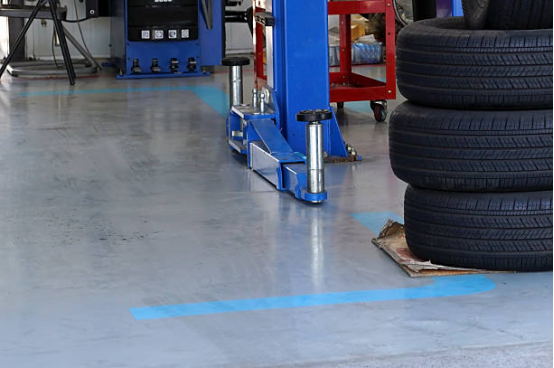
Pressure sources in high-wear scenarios
Why Garage Floor Coating Must Be “Strong” Enough
In high-traffic garage floors, the sources of wear and tear vary significantly, ranging from slow to sudden and intense, and from complex pressures resulting from a combination of chemical and mechanical factors. This makes the durability of garage floor coatings crucial.
- Tire wear is not as “gentle” as you might imagine.
When a vehicle enters a garage, fine sand, metal dust, and leaf debris from the tires are pressed into the tire coating. Every turn is like a tiny piece of sandpaper gently rubbing against the ground. While this might not be noticeable at first glance, the cumulative effect over time on garage floor coatings is extremely strong and can wear down even the toughest layers. - “Impact wear” caused by falling tools.
Items like wrenches, jacks, and metal tripods can cause significant damage when they fall onto the garage floor coating. While they might not immediately penetrate the surface, they create micro-pits. Over time, repeated impact from these tools causes the pits to expand and, eventually, results in small-scale peeling of the floor coating. - Chemical abrasion.
In a workplace setting, oils, brake fluid, engine oil, and acidic cleaning agents can all penetrate the garage floor coating. If the coating isn’t chemically resistant enough, it will gradually lose its hardness, surface gloss will dull, and sticky marks will appear. This further emphasizes the need for high-quality garage floor coatings that can withstand the rigors of both mechanical and chemical wear.
These seemingly trivial details constitute the entirety of floor wear and tear. They also determine why durable garage floor coatings must have sufficient thickness, resilience, and a scratch-resistant structure. Without a solid coating base layer, even the most beautiful decorative textures will struggle to withstand the high wear and tear of daily use.
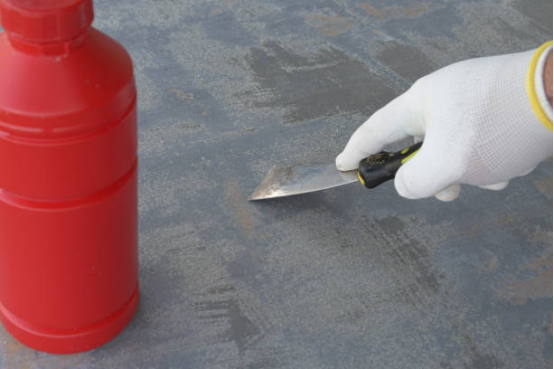
How laboratory abrasion resistance tests assess coating strength
Taber Abrasion, Sandfall Test and Composite Structure Analysis
Garage Floor Coating: Within the industry, the most frequently cited tests include:
1. Taber Abrasion Test
This test is widely used to evaluate wear resistance. The tester uses two grinding discs to continuously rub the sample surface and records the weight loss of the coating after a certain wear cycle.
One piece of experience is:
- High-grade wear-resistant coating: wear loss less than 50 mg after 1000 cycles.
- Ordinary flooring materials: may exceed 90mg
- Weak abrasion-resistant structure: even exceeding 130mg
Industry professionals generally believe that a low abrasion value means the coating is less likely to be scratched and more resistant to tool dragging.
2. Falling Sand Abrasion Test
It simulates the process of fine sand and hard particles scraping the ground over a long period of time and is especially suitable for driveway areas.
If the etching depth caused by the abrasive grains is small per unit time, it indicates that the coating structure is dense and has high scratch resistance.
3. Coating structural layer analysis
Some abrasion-resistant coatings essentially rely on the layering of different layers:
- Bottom layer: Adhesion
- Middle layer: Compression-resistant resin
- Surface layer: A scratch-resistant layer combining hardness and elasticity.
The structural design determines whether it can truly withstand the daily wear and tear of a high-traffic garage floor.
Realistic performance of Garage Floor Coating in high-wear scenarios
Differences in user experience and performance under prolonged trampling
Based on feedback from many real garage users, the durability of a coating is determined not only by material parameters, but more by the long-term stress caused by environmental differences.
1. Tool-intensive areas: Localized wear from metal is the most fatal.
Workshop floors often wear out faster than driveways. This is because tools are often not gently placed down, but rather “tossed aside.”
The edges of metal objects are extremely hard; a single impact may not destroy the coating, but a dozen or so impacts can leave micro-dents.
Garage Floor Coating with a thicker abrasion-resistant layer performs significantly better in this scenario:
- Micro-pits are not easily enlarged
- Scratches are not easy to penetrate to the middle layer
- The coating will not exhibit “tearing peeling” due to deep wear.
2. Lane area: Minor erosion caused by repeated rolling.
The garage driveway is a typical high-traffic garage floor.
Especially in areas with significant seasonal temperature differences, the ground will slightly contract with the alternation of hot and cold, while the pressure of the tires when the car is warm will increase friction.
In this area, users typically report:
- A high-quality coating retains its shine even after two years.
- Medium quality may appear slightly dull.
- Inferior coatings may exhibit scratches or dark streaks resembling “driving tracks.”
If the coating has insufficient scratch resistance, it will appear to age quickly even if the surface still adheres well.
3. Chemical environment: Additional abrasion caused by oil and cleaning agents.
The most easily overlooked wear and tear in garages comes from chemical reactions.
If a garage floor coating performs poorly in terms of chemical resistance, users will often see:
- The coating surface softens
- A localized sticky feeling occurs
- The gloss becomes more like a matte finish than a glossy finish.
- Shadow marks remained even after cleaning.
These are all signs that chemical abrasion has led to a decrease in coating hardness.
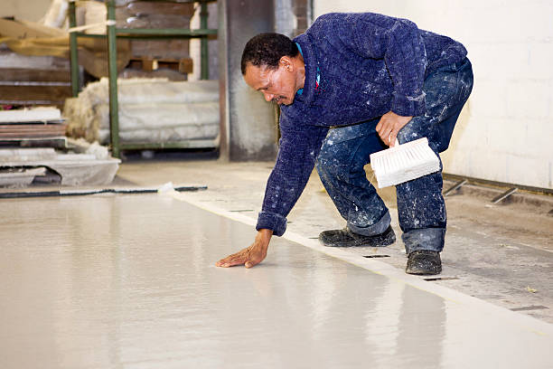
How to determine if the abrasion resistance of a garage floor coating is sufficient?
In addition to test data, attention should also be paid to the adaptability to real-world application environments.
The abrasion resistance of a coating depends not only on the label or lab results but also on whether it is suitable for your garage usage.
1. If your garage is frequently used as a workspace
Prioritize resistance to metal impacts and surface hardness.
In these scenarios, tools are dropped or dragged more frequently than wheels wear down.
2. If your garage frequently has multiple cars parked in it or has frequent entry and exit points…
Greater emphasis is placed on surface density and scratch-resistant structure.
Low-density coatings will quickly wear out under high-flow conditions.
3. If your area experiences large temperature differences and significant humidity fluctuations.
A more stable elastic layer is needed to prevent micro-cracks.
4. If the garage will come into contact with oil, solvents, or alkaline cleaning agents.
Special attention should be paid to its resistance to chemical corrosion; otherwise, the surface will easily soften.
In other words, for a coating to truly achieve durable garage flooring , it must not only be hard, but also flexible, chemical-resistant, and adaptable to different usage patterns.
Wear-resistant coatings are not some kind of “mysticism,” nor are higher parameters always better.
Through industry testing, user feedback, and summarizing real-world wear and tear scenarios, you’ll find that the durability of Garage Floor Coating is not determined by a single element, but rather by a comprehensive result of multiple dimensions.
Wear resistance comes from:
- Surface hardness
- Mid-layer compressive strength
- Chemical stability
- Elasticity of composite structures
- Adaptability to high-traffic environments
If you’re looking for a coating system that can truly support your daily work and vehicle traffic, perhaps you should start by understanding how you use your garage. Different sources of wear and tear require different solutions, and understanding those needs is the first step to making your floors more durable.
Exploring more aspects of garage floor coating may offer further inspiration.
Wear-resistant flooring isn’t futuristic technology but a functional experience you can have right now. The next time you step on a clean, smooth surface, you might suddenly realize—true durability is something that exists silently.


