
Many people first become truly aware of garage odor issues not on the day of construction, but on a morning afterward. The moment the door opens, the lingering pungent smell suddenly becomes clear, even seeping into the room through the door cracks. At that moment, people begin to ask, “Where is this smell coming from?” How long will it last? Will it affect the daily experience and sense of security of family members? In discussions surrounding garage floor coatings, odor is often an underestimated yet most readily apparent factor.
Odor is not caused by a single factor. It is closely related to the coating system itself, the chemical reactions during the construction phase, the VOC release rate, and ventilation conditions. Understanding these mechanisms helps explain why some garages return to normal within days after construction, while others remain unpleasant for weeks.
Where do the odors come from during construction? It’s not just as simple as “pungent.”
The odor is often most noticeable during the construction phase of garage floor coating. Many users simply attribute this odor to a “chemical smell,” but from a professional perspective, it is more likely the result of a combination of various volatile components.
First, there’s the evaporation of solvents and reactive diluents. Some coating systems require solvents to adjust flowability or application properties during application. These components evaporate rapidly after coating, creating a typical garage floor odor. The differences between systems are significant; some have a sharp, fleeting odor, while others are stronger and linger longer.
Secondly, there’s the curing reaction itself. Even systems touted as low-odor coatings undergo chemical cross-linking during curing. This process may release trace amounts of gas; although the concentration is low, it can still be noticeably detected in enclosed or semi-enclosed garage spaces. Industry experience shows that the day of application and the first 24 hours afterward are the window of highest odor concentration.
Ventilation plays a crucial role at this stage. Even with the same garage floor coating, the odor experience can be completely different in an open garage versus a closed underground garage. Low air exchange rates can trap odors that would otherwise be fleeting in the space, amplifying the discomfort.
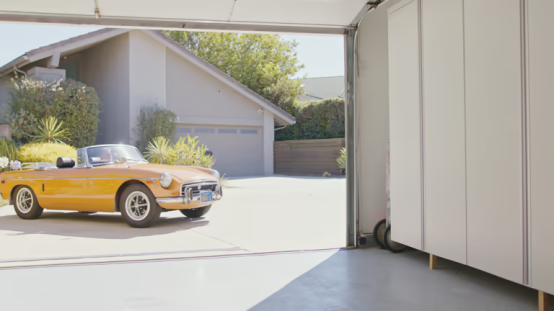
The role of VOCs: from sensory stimulation to psychological safety
garage floor coatingWhen discussing odors, VOCs are unavoidable. The concept of VOC emission in Garage Floor Coating has been frequently mentioned in the flooring industry in recent years, not only because of stricter regulations but also because users are becoming more sensitive to their living environment.
garage floor coatingVOCs are not synonymous with “toxic,” but they are indeed highly correlated with odor perception. Some VOCs have a distinct odor threshold, meaning people can still clearly smell them even when their concentration is far below the safety limit. This is why some families, while rationally aware that their Garage Floor Coating levels are “compliant,” still feel uneasy.
garage floor coatingFrom a user experience perspective, VOC emissions from garage floor coating are primarily concentrated during the application and early curing stages. As the reaction completes and residual components evaporate, emission levels gradually decrease. Multiple industry tests have shown that for most Garage Floor Coating systems, VOC emissions tend to stabilize after full curing, and the odor disappears or becomes extremely faint.
However, the psychological impact often lags behind actual data. Persistent garage floor coating odor easily evokes associations with health risks, even if such associations are not always scientifically based. Therefore, understanding the sources and fluctuations of VOCs in garage floor coating is itself an important part of enhancing family safety.
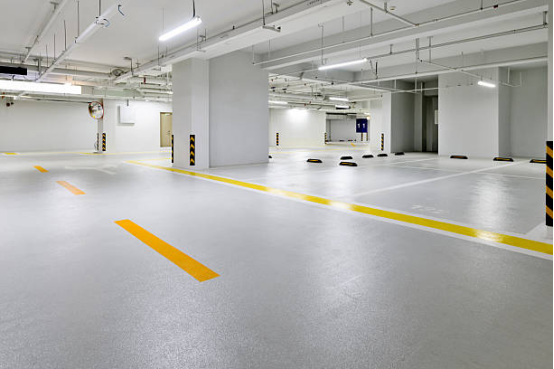
Odor changes over long-term use: Why do some garages become less smelly the longer they are used?
An interesting phenomenon is that many users report a noticeable odor immediately after garage floor coating is applied, but after a few months, their garages are actually “cleaner” than before. This is not an illusion but rather related to the interaction between the concrete and the coating.
Untreated or aged concrete is itself a “storage vessel” for odors. Oil stains, fuel residues, and cleaning agents seep into the pores and are slowly released when temperatures change, creating a persistent background odor. Once the coating has fully cured, it seals these pores, blocking the continuous release of odors from their source.
From this perspective, garage floor coating can actually help improve garage floor odor in the long run. Many car owners have mentioned that the smell, which was originally a mixture of engine oil and damp dust, gradually disappears after the coating is applied and stabilized, only appearing briefly when the vehicle is first parked.
Of course, such improvements don’t happen overnight. They depend on sufficient initial construction, complete curing, and avoiding excessive pollution during subsequent use. Low VOC doesn’t mean zero odor, but rather that odor is more controllable and shorter-lived.
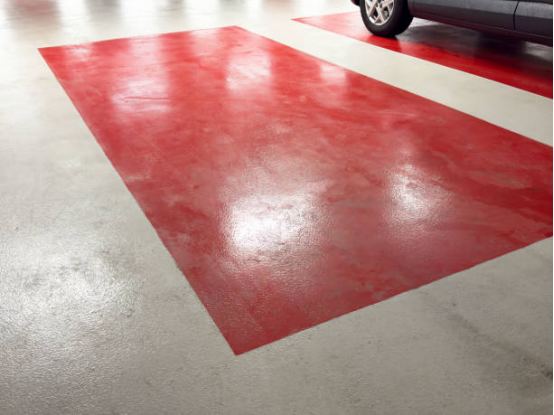
Ventilation and Time: Two Underestimated Variables
Of all the factors that influence the odor experience, ventilation and time are often the most easily overlooked. People focus more on the materials themselves but underestimate the amplifying or buffering effect of environmental conditions.
During construction, good air circulation can significantly reduce odor peaks and shorten the duration of discomfort. Even systems with relatively restrained VOC emission flooring can create a feeling of oppression in a completely enclosed environment. Conversely, in spaces with good convection, odors tend to dissipate more quickly.
Time is another key variable. Many negative reviews about the odor of Garage Floor Coating are concentrated in the first few days after application. This doesn’t mean the problem will persist but rather reflects the inevitable stage of the initial curing process. As the reaction completes, the odor intensity typically decreases exponentially.
Some experienced construction workers would suggest, if conditions permit, giving the garage a “buffer period” to allow the odor to dissipate naturally before resuming high-frequency use. This approach is not superfluous but rather respects the rhythm of the materials’ chemical processes.
Judgment Behind Scent: How to Balance Reason and Feeling
Discussions about the smell of garage floor coating ultimately come down to one question: is data more important, or is feeling more important? The real answer is often somewhere in between.
From a professional perspective, VOC testing, emission standards, and curing curves provide objective evidence for judging safety; from a family experience perspective, olfactory perception and psychological comfort are equally real factors. Ignoring either aspect will throw the discussion off balance.
Understanding the sources of odor in different coating systems during application and long-term use helps transform “uncertain concerns” into “predictable processes.” When people know why odors appear, when they diminish, and whether they are controllable, their sense of security naturally increases.
Perhaps it’s worth pausing to consider this: is it the fleeting smell that’s truly unsettling, or the silence that follows its lack of explanation? When Garage Floor Coating is placed within the correct cognitive framework, the smell is no longer just a problem but rather part of the information.


