The Hidden Game Between Garage Floor Coating and Floor Friction Coefficient

Table of Contents
Have you ever had this experience: on a rainy day, you drive your car into a newly built, gleaming garage, and when you get out, your feet touch a little puddle, and it instantly feels like you’re stepping on an oiled Teflon frying pan?
The racing heart and almost uncontrollable muscle tension at that moment were a kind of panic that no amount of beautiful decoration could make up for.
This is what we in the industry often call the “showroom trap.”
Most people are dazzled by the mirror-like high-gloss reflection when choosing a garage floor coating. Here’s a harsh physics fact: glossiness is usually inversely proportional to safety.
Many people think that coatings are only for aesthetics or dust prevention, but they overlook its most important engineering indicator—the garage floor coating friction coefficient. Today, we won’t talk about aesthetics, but only about how to make your floor both beautiful and protect your knees in slippery conditions from a safety engineering perspective.
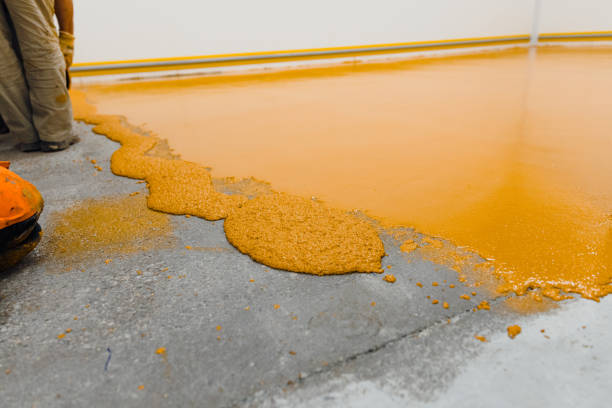
Coefficient of friction (COF): The 0.5 threshold that determines life or death.
In engineering, we use COF (Coefficient of Friction) to measure grip resistance. Simply put, 0.0 is like ice, and 1.0 is like Velcro.
According to OSHA (Occupational Safety and Health Administration) standards, a safe walking surface must have a COF of at least 0.5 and 0.8 for ramps.
Garage floor coatings—whether epoxy or polyurea—exhibit excellent COF (coefficient of friction) performance when completely dry, typically reaching 0.7 or even higher. When you step onto the dried, cured resin with your rubber sole, the grip is incredibly solid, even better than smooth cement.
But there’s a detail that most people overlook: this high grip is based on “dry contact.”
Once a medium is introduced—such as rainwater, snowmelt, or even a little bit of engine oil—a normal smooth, high-gloss coating will immediately exhibit a “water film effect.”
Water molecules will form an extremely thin lubricating film between the sole and the coating, instantly lowering the COF to below 0.2.
This is no longer walking; it’s gliding without protection.
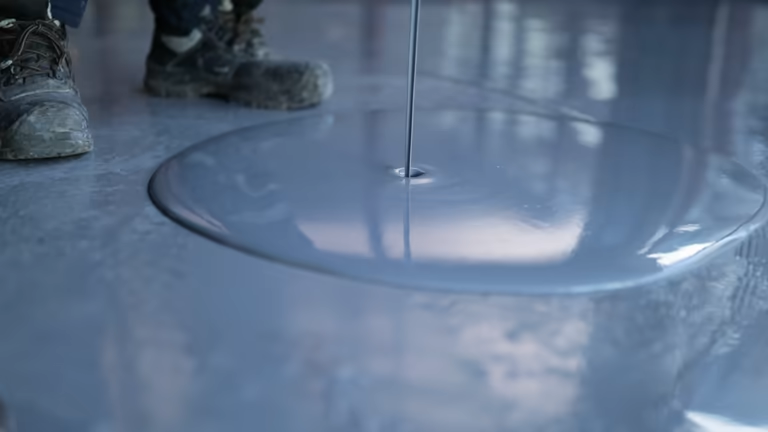
The Art of Particles: How to Embed Nails in a Mirror
Since smoothness is the original sin, the solution is roughness. But in practice, it’s not as simple as sprinkling sand into the paint.
This involves industry secrets. Many low-end construction teams refuse to add anti-slip aggregate to save time.
Why? Because the leveling properties of garage floor coatings with added aggregate are difficult to control, easily leaving roller marks and losing that high-end “glass-like” finish, resulting in a less bright appearance during customer inspection.
However, the professional approach requires suspending a special type of particle in the topcoat—usually aluminum oxide or polymer microbeads.
Even the most basic garage floor coating becomes completely different when 60-mesh alumina particles are added. These tiny particles, almost invisible to the naked eye, are like countless miniature nails.
When you step on it, your weight forces the rubber sole to deform, encasing these tiny protrusions. This physical “mechanical interlock” can pierce the water film and establish friction directly at the microscopic level.
The feeling is amazing: it doesn’t feel prickly to the touch, but when it’s wet and slippery, you can clearly feel a “gritty” sensation under your feet, which is the granules working.
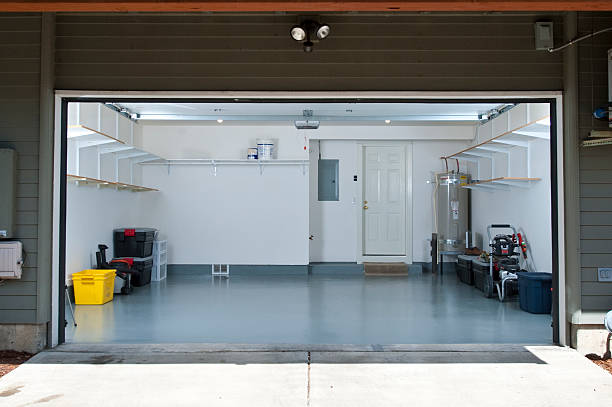
Flakes: An underestimated source of friction
Besides the invisible aluminum oxide, covering the entire floor with vinyl flakes is actually the most direct way to increase the friction coefficient of the garage floor coating.
Many people think that scattering those colored fragments is just for aesthetics or to mimic the texture of granite. That’s wrong.
When full-broadcast sheets are encased under a varnish, they naturally develop a textured structure similar to “orange peel.”
This uneven surface disrupts the continuity of the water film. The water cannot form a complete plane but is instead scattered across countless tiny pits.
This explains why garages fully covered in flake flooring, even without additional anti-slip sand, are much more stable to walk on than solid-color epoxy floors.
Sensory Test:
You can conduct an experiment. Pour a glass of water onto:
- Regular garage floor coating: the water will either bead up perfectly or spread into a thin film. This results in a slippery surface.
- A fully sheeted floor: the water will quickly disperse in the textured surface. This ensures safety.
The cost of this “safety” is a trade-off between cleaning difficulties
As an honest expert, I must tell you the other side of the coin.
The greater the friction, the rougher the surface, and therefore the harder it is to clean. That’s the fair trade-off in physics.
If you demand the contractor use 40-mesh or even coarser quartz sand for ultimate safety, your garage will indeed be as slip-resistant as sandpaper, and you’ll even hear the tires screeching when you start your car.
However, you’ll be in for a rude awakening when you try to clean the floor with a cotton mop.
A rough garage floor coating will shred your mop like a shredder, leaving lint everywhere.
Plus, grease and dirt will get stuck in those deep crevices that provide the friction, and regular scrubbing won’t remove them; you’ll have to use a pressure washer.
Therefore, the most perfect garage floor coating is not the most slip-resistant but rather the one that is at the “sweet spot“:
- It typically uses 60-80 mesh spherical polymer microbeads with an orange peel texture.
- This surface feels like fine basketball leather, providing sufficient dry and wet friction (COF > 0.6).
- It also allows the microfiber mop to glide smoothly over, with no hard-to-reach areas for cleaning.
FAQ (Frequently Asked Questions)
Q1: I have already applied a smooth garage floor coating. Is there any way to improve its slip resistance?
A: Yes, but there will be a slight compromise. You can’t just spread sand directly onto the hardened surface.
You’ll need to lightly sand the existing surface to increase adhesion, then roll on a thin layer of clear topcoat, and while the topcoat is wet, sprinkle in an anti-slip additive (such as aluminum oxide). This will increase the coating thickness slightly, but it will immediately improve the friction coefficient of the garage floor coating.
Q2: Since anti-slip is so important, why do DIY kits usually only include a small amount of anti-slip sand?
A: This is a typical case of cost and application difficulty control. DIY users often lack the skills for quick roller application.
If too much anti-slip sand is used, it can easily settle or accumulate, causing some areas of the surface to resemble sandpaper while others resemble a mirror. To reduce complaints, manufacturers usually only provide a very small amount of additive or advise you to use less. From a safety perspective, this is actually insufficient.
Q3: Are the friction requirements for garage floor coating the same under different climatic conditions?
A: Completely different.
- If you live in Arizona, where you mainly deal with dust, a medium grip is sufficient.
- But if you’re in Minnesota or Canada, where your car brings in a lot of snow and icy water in winter, you need heavy grip. In these environments, don’t aim for a mirror finish; you must ask the contractor to increase the density and particle size of the aggregate, even if it means sacrificing a little gloss.
Q4: Which is better, aluminum oxide or polymer beads?
A: It depends on your needs. Here’s a comparison:
| Feature | Aluminum Oxide | Polymer Microbeads |
|---|---|---|
| Hardness/Shape | Harder and sharper | Round |
| Anti-slip Properties | Excellent | Slightly weaker |
| Wear Resistance | More wear-resistant | Less wear-resistant (implied by “rounder”) |
| Comfort (barefoot) | Less comfortable (implied by “sharper”) | More comfortable to walk on barefoot |
| Cleaning Ease | Harder to clean (implied by “sharper” & “excellent anti-slip”) | Easier to clean |
| Ideal Use | Heavy-duty garages | Garages used as home gyms or entertainment rooms |
Conclusion
When we talk about garage floor coating, don’t be fooled by the glamorous photos.
The garage is first and foremost a functional space and only secondarily a display space.
In this space, several tons of metal machinery are moving, rain-soaked shoes are walking, and sharp tools are falling.
The ground is your last line of defense in this dangerous environment.
A good floor coating system should work without you even noticing. It shouldn’t make you feel slippery when you brake, nor should it make you lose your footing when you lift heavy objects.
The next time you review that coating quote, ask, “What’s your anti-slip solution?” This one question might save your hip joint on a rainy night someday.
Remember, friction is invisible, but you can definitely feel it.


