
Whether you’re a car lift enthusiast who just bought one or a middle-class person planning to turn your garage into a home gym, the most dangerous thing I hear during consultations is, “I think the floor is a bit brittle. Shouldn’t applying a thick layer of garage floor coating be enough to support the weight?”
Whenever I hear this, I feel a chill run down my spine.
This isn’t just a waste of money; it’s a safety hazard.
Many people are misled by the exaggerated advertisements on the market—as if simply applying some kind of magical epoxy resin or polyurea could instantly transform your ordinary concrete floor, which doesn’t even have steel reinforcement, into an aircraft carrier deck.
As a veteran of ten years in the chemical coatings and garage renovation industry, I have to throw some cold water on your thinking: Garage floor coating is the skin, and the concrete base is the skeleton. Have you ever seen anyone use a tattoo to treat a broken bone?
Today, we’re going to tear off this fig leaf and talk about the real logic behind garage floor load capacity coating: Is it protecting your floor or covering up an impending collapse?
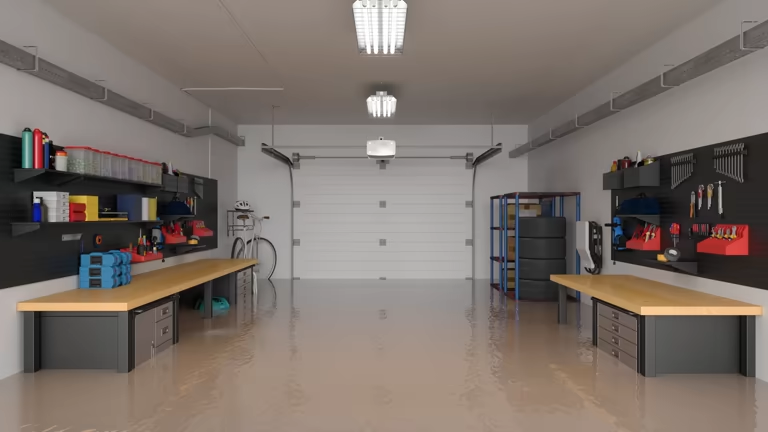
The digital game about “PSI”
You’ve probably seen data like this in some paint product brochures: “Our coating has a compressive strength of up to 10,000 PSI, which is 3 times stronger than ordinary concrete!”
Is this statement true? Yes.
Does this mean your floor’s load-bearing capacity has increased? Absolutely not.
This is a classic example of a “marketing deception.” Garage floor coatings (whether epoxy or polyurea) are indeed very hard. If you hit a block of cured epoxy with a hammer, it might not budge.
But there is a very simple physical logic here: the coating is attached to the concrete surface.
Imagine you place a steel plate (coating) on a block of tofu (concrete) and then stomp on the steel plate. The steel plate doesn’t break, but the tofu underneath crumbles.
The concrete grade of most ordinary residential garages is around 2500 to 3000 PSI. When you apply a 10,000 PSI coating on top of this, the overall load capacity of the floor is still limited to 3000 PSI—that is, the weakest link.
If your vehicle or equipment weighs more than the concrete slab can withstand, the base will settle or break.
At that point, the only thing your expensive coating can do is either crack along with the cracked concrete or act like a sticker, holding the two separated concrete blocks together until it is torn apart.
So don’t expect the coating to help you withstand that 4-ton twin-post lift.
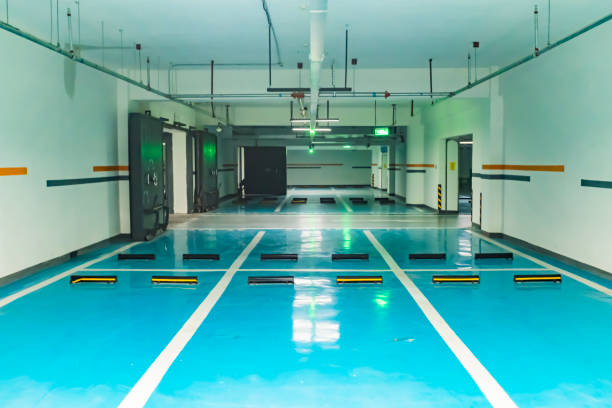
It doesn’t bear weight, but it can withstand “microscopic violence.”
Since the coating cannot increase the structural load-bearing capacity, why should we spend thousands of dollars to do it?
Because “structural load-bearing capacity” and “surface wear resistance” are two different things. It’s like how a tattoo can’t cure a broken bone, but wearing armor can protect you from knife cuts.
While untreated exposed concrete may appear hard, under a microscope it is actually a sponge full of pores.
When you lift the car with a floor jack, those four small metal wheels bear enormous point pressure.
You can recall that sound—the teeth-grinding “crunch” of metal wheels rolling on concrete, accompanied by fine dust. That’s the concrete surface being crushed and ground.
This is where the value of garage floor coating becomes apparent.
It provides a “sacrificial layer.” When the jack wheel presses down, the high-hardness, high-toughness coating withstands the shear force from this localized point load.
It prevents the concrete surface from dusting and spalling.
This is like putting a Kevlar bulletproof vest on your ground. It can’t stop bullets (due to excessive overall load), but it can stop the cuts from a knife (due to friction from a jack and tools).
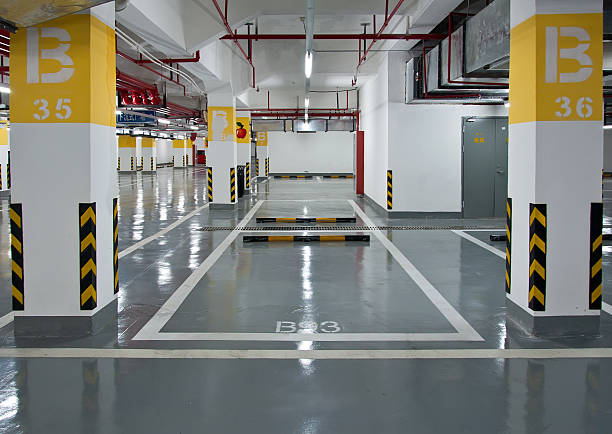
The real “load-bearing” killers: liquid penetration and freeze-thaw cycles
Besides physical weight, there is actually a more hidden force that is destroying the load-bearing capacity of your garage floor, and this is exactly what Garage Floor Coating can solve.
That is the erosion caused by water and chemicals.
Without a coating, winter snowmelt mixed with road salts will seep into the concrete like a sponge absorbing water.
When temperatures plummet, this moisture freezes and expands in the concrete’s capillaries, creating internal tension strong enough to break the cement apart from the inside.
This repeated freeze-thaw cycle will erode the foundation’s strength like termites.
Once the internal structure of concrete becomes loose, its load-bearing capacity decreases exponentially. What might have been able to support a pickup truck last year could crack even under the weight of a sedan this year.
At this level, Garage Floor Coating, through its dense chemical cross-linking structure, completely seals off the channels for liquid intrusion. While it doesn’t directly “add bones” to the ground, it prevents “osteoporosis.”
For car owners living in cold regions or by the sea, this membrane is like extending the life of the foundation.
FAQ (Frequently Asked Questions)
Q1: If my floor already has cracks, can Garage Floor Coating cover and reinforce them?
A: This is a classic misconception about garage floor load capacity coating.
While the coating can indeed fill hairline cracks, making the floor look brand new, it won’t hold if the cracks are “active cracks” caused by foundation settlement or structural fractures. Within months, the coating will tear again along the original cracks.
You must first perform structural repairs with polyurethane or epoxy repair mortar, or even sand it smooth, before applying the coating.
Q2: Since the coating does not increase the load-bearing capacity, what should I pay attention to when installing a car lift?
A: Never believe coating vendors who say, “You can install it as soon as you paint it.” When installing a lift, you need to pay attention to the thickness of the concrete (at least 4-6 inches) and its grade (3000 PSI or higher).
Installers usually drill holes and use expansion bolts. My advice is to install the lift before applying the garage floor coating or cut off the coating at the installation point to ensure the base is in direct contact with the concrete.
This prevents the coating from cracking under pressure due to bolt torque, which could cause the base to loosen.
Q3: Which is better for ground protection, epoxy or polyurea?
A: From a compressive strength perspective, both far surpass concrete.
However, polyurea’s advantage lies in its flexibility. When concrete is subjected to thermal expansion and contraction or slight vibration, epoxy resin with excessive hardness may crack, while polyurea has better elongation and can adapt to the slight deformation of the substrate like rubber, thus ensuring continuous waterproof protection.
Q4: Will hot tire pickup after parking damage the load-bearing layer?
A: Hot tires won’t damage the concrete structure, but they will tear off inferior coatings.
When you’ve just driven on the highway, the tires are extremely hot, and the rubber molecules open up. During the cooling process, the tires and coatings can “stick” together.
If you start driving again and the coating isn’t strong enough, it will tear off the tires and the surface. This doesn’t affect the load-bearing capacity of the foundation, but it will instantly damage your surface, leaving it without a protective layer.
Using industrial-grade, high-solids garage floor coating is the only solution to this problem.
Conclusion
Returning to the original question: Is garage floor coating a scam?
If you expect it to support a tank on your 4-inch-thin foundation, then it’s a waste of money. But if you think of it as “protective armor” for concrete, protecting it from wear, chemical corrosion, and moisture penetration, then it’s the most worthwhile investment you can make in your garage.
We need to distinguish between “structural capabilities” and “surface capabilities.”
Don’t try to repair a broken bone with paint. First, check your concrete base to make sure it’s healthy and thick enough.
Then, donate that expensive, beautiful, and indestructible garage floor coating.
This is the greatest respect you can show to your car and your house. Remember, the foundation determines life or death, and the coating determines lifespan.


