How does high humidity affect the curing and adhesion of garage floor coating?

Table of Contents
You checked the weather forecast and confirmed that there would be no rain for the next two days. You emptied the garage, sanded the floors, mixed the expensive paint, and confidently began construction.
However, when you opened the garage door the next morning, the expected crystal-clear, showroom-like shine didn’t appear. Instead, the floor was covered with a layer of murky white spots, like milk, and even felt a little greasy to the touch.
You didn’t do anything wrong, but the result was a disaster.
high humidity.Welcome to the most hidden pitfall in garage floor coating installation: High Humidity.
Many DIY enthusiasts and even inexperienced contractors only focus on the visible indicator of “rain,” ignoring the invisible moisture in the air that is quietly disrupting the chemical reaction.
Today, we’ll delve into a chemical phenomenon known as “blushing” and teach you how to protect your flooring in humid climates.
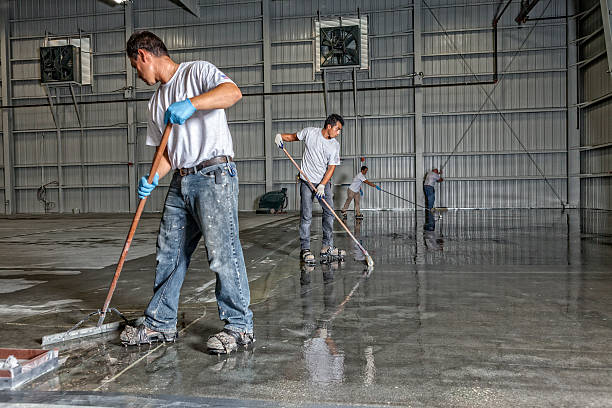
A micro-level “love triangle”: What is epoxy floor blushing?
To understand why humidity can ruin your floors, we need to start with a simple chemistry lesson.
A standard epoxy flooring system consists of two parts: component A (resin) and component B (curing agent, usually an amine). Ideally, components A and B mix together, bind tightly together, and undergo a cross-linking reaction to form a hard plastic.
However, component B (amine) has a bad habit: it is very “hydrophilic.”
When the humidity in the air is too high, a microscopic “love triangle” begins. The curing agent (amine) betrays the resin and instead reacts with moisture (H₂O) and carbon dioxide (CO₂) in the air.
This is epoxy floor blushing.
This unexpected chemical reaction produces a byproduct—amine carbamate. This substance is a waxy or oily salt that floats on the surface of the coating, leading to the following consequences:
- Visual defects: The surface has milky white, cloudy spots and uneven gloss.
- Oily to the touch: It feels sticky and can’t be washed off.
- Chemical inertness: Most fatally, this oil film will prevent the adhesion of the next layer of paint.
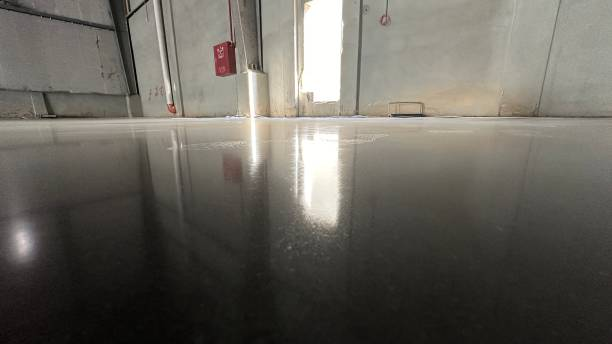
Dew Point: A more critical indicator than relative humidity.
Now that we understand the principles behind moisture problems in epoxy applications, how can we prevent them? Many people only look at the “relative humidity” (RH) on their phones, and if it shows 60% or 70%, they think there’s no problem.
That’s completely wrong. In floor construction, the real arbiter is the dew point.
Dew point is the temperature at which water vapor in the air begins to condense into liquid water. Here’s a golden rule you absolutely must memorize:
The ground temperature must be at least 5°F (3°C) higher than the dew point temperature.
If epoxy is applied in a high-humidity environment and the ground temperature is close to the dew point (for example, when the ground gets cold at night), a tiny, invisible film of condensation will form on the concrete surface.
If you apply paint over this invisible film of water, the coating simply cannot penetrate the pores of the concrete; instead, it floats on the water. Once the moisture evaporates, your floor will bubble and peel. This is why many projects started in the morning or evening inexplicably fail.
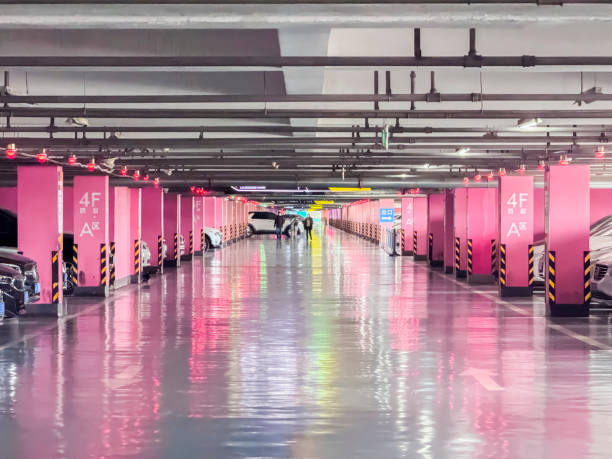
Is it really impossible to do construction work on rainy days? Common misconceptions about Garage Floor Coating Rain
This is a classic question: It’s pouring rain outside, but I’m working in a closed garage. Is that okay?
This involves the long-tail effect of garage floor coating rain.
- Extremely high humidity: Rainy days usually mean that the relative humidity is close to 100%. At this time, the probability of epoxy floor blushing of the hardener is 10 times that of a sunny day.
- Concrete moisture reabsorption: Concrete is like a hard sponge. If the soil outside the garage absorbs rainwater, the moisture will seep through the foundation via capillary action, attempting to evaporate from your garage floor. Forcing a sealant at this point is like putting a lid on this wet sponge; the moisture pressure will eventually force the coating off.
- Industry advice: If it rains for more than two consecutive days, or the air humidity remains above 85%, even indoors, it is recommended to postpone construction.
Survival Guide in Humid Climates: How to Save Your Project Schedule
If you live in a coastal area or during the rainy season, completely dry days may be a luxury. But that doesn’t mean you can’t do construction; what you need is a more meticulous approach.
1. Create a microclimate
Don’t rely on natural air drying. Close the garage door (leaving a crack for ventilation), and use an industrial dehumidifier and air conditioning.
Simply using a fan isn’t enough; fans only move air, they don’t remove moisture. Your goal is to forcibly lower the dew point indoors.
2. Choosing the right material: Polyaspartic vs. Epoxy
This is the ultimate weapon against humidity. Traditional epoxy resins are very sensitive to humidity, but polyaspartic technology is different.
Polyaspartic utilizes moisture in the air to aid curing, and its tolerance to trace amounts of moisture is far greater than that of epoxy. In humid environments, using polyaspartic as a topcoat or even a primer can significantly reduce the risk of whitening.
3. Avoid times when you sweat.
Concrete cools overnight, and as the air temperature rises in the morning, the ground heats up more slowly than the air, making it most prone to condensation.
The optimal construction window is usually between 10 a.m. and 2 p.m., when the ground temperature has already risen and there is a safe buffer period before the evening cooling.
Conclusion
In the world of garage floor coating, patience is the most expensive material but also the most cost-effective tool.
High humidity and invisible moisture are destroyers of chemical reactions. They not only make your floors look moldy but also physically damage the adhesion between the coating and the substrate.
When you’re hesitating about whether to do it today, grab a simple infrared thermometer and hygrometer to check the dew point. If the data isn’t up to par, put down the roller and grab a coffee. Waiting for a dry, sunny day is far more worthwhile than spending thousands of dollars and an entire weekend shoveling up a failed floor.
FAQ
Q1: If my floor has already developed epoxy floor blurring (whitening/greasy), is it still possible to fix it?
Yes, but it’s troublesome. Once whitening occurs, the surface is not only unsightly but also chemically inert, making it impossible for a new coating to adhere.
- Slight whitening: You can try cleaning with warm water mixed with citric acid or a special solvent to neutralize and remove the carbamate oil film on the surface.
- Severe whitening: The white layer on the surface must be completely sanded off with a sander until the healthy coating underneath is exposed. Then wipe it clean with solvent and repaint the topcoat.
Q2: Since it’s afraid of water, should I use a spray gun to dry the ground before painting?
This is a high-risk operation. While heating can temporarily remove surface moisture, it also drastically raises the temperature of the concrete. Applying cold paint to a scorching hot surface can cause the paint to flash set or even outgas. The correct approach is to use air conditioning or a dehumidifier to regulate the overall ambient temperature and humidity, allowing them to reach a natural balance.
Q3: Why is polyaspartic better in scenarios where epoxy is applied in high humidity?
Besides its inherently hydrophobic chemical properties, curing speed is crucial. Epoxy resins require 6-12 hours to surface dry, giving airborne moisture ample time to react. Polyaspartic, on the other hand, typically surface dries within 1-2 hours, significantly closing the “time window” for moisture intrusion and preventing whitening from occurring.


