Analysis of the odor and low-odor formulation of Garage Floor Coating

Table of Contents
The construction crew has just left, and your new garage floor looks gleaming and stunning. But a few hours later, as you step into your upstairs bedroom to relax, a pungent chemical smell, like nail polish or super glue, hits you.
Your head starts to throb, and you begin to worry about your child napping in the next room.
For homeowners with attached garages, especially those whose master bedroom is directly above the garage, the smell of garage floor coating is not just a matter of comfort but also a serious health concern.
Many homeowners, in their pursuit of durability and aesthetics in flooring, often overlook the “air quality during construction.”
Sources of odor: The physics of solvent evaporation
To solve the odor problem, you first need to know where it comes from.
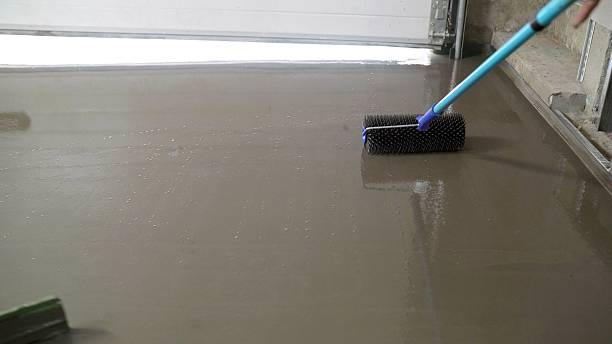
The nauseating smell you get from traditional, inexpensive floor coatings mainly comes from solvents. These solvents (such as xylene and acetone) keep the coating liquid, making it easy to apply. Once the coating comes into contact with the ground, these solvents begin to evaporate (off-gassing), leaving behind solid resin.
toxic gas full of VOCs (volatile organic compounds).
Why are the rooms above the garage the most dangerous?
This involves a building physics phenomenon known as the “stack effect.” Hot air rises, and if your garage is connected to the indoor HVAC system, or even just due to gaps in the floor slab, VOCs that accumulate near the garage ceiling can seep upwards through pipes or gaps directly into your living area.
For older solvent-based epoxy resins, this intense release process can last 24 to 48 hours, and the residual odor can even linger for weeks.
Investigation: Is Epoxy Fume Toxic?
Searching for “is epoxy fume toxic” on Google, the answers are often complicated.
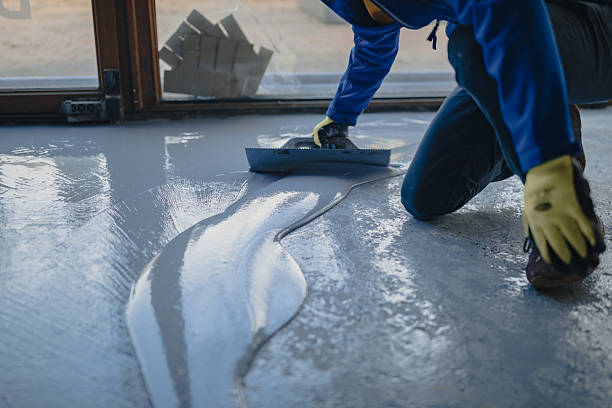
In short, cured epoxy resin is inert and non-toxic. However, solvent-based products containing high concentrations of VOCs during the liquid and curing processes do pose health risks.
Short-term effects:
- headache
- dizziness
- nausea
- eye and respiratory irritation
This is your body telling you, “Get out of here.”
High-risk groups:
- Children
- pregnant women
- asthma patients
- pets (especially birds) that are sensitive to chemicals
These groups have very low tolerance to these fumes.
Therefore, if your contractor brings you a can of paint that is labeled “Flammable” and contains a large amount of solvent, and your family lives upstairs, please stop immediately.
Looking for Low VOC Epoxy Floors and Solvent-Free Technologies
The good news is that modern chemical technology has provided us with perfect alternatives. For the health of your family, you need to learn to identify the following two types of products:
1. 100% Solids Epoxy
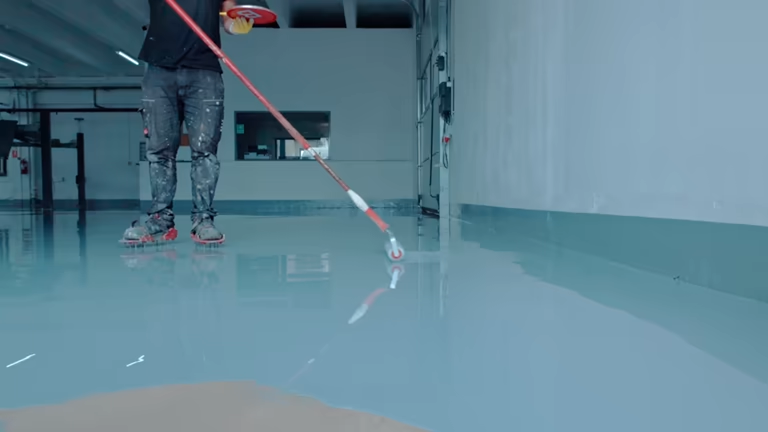
This is the gold standard in the professional field. Unlike cheap products containing 50% solvent, 100% solids means the bucket is full of effective resin and hardener, with no solvent and no water.
- Principle: It does not dry by “evaporation” but by “chemical cross-linking” to solidify.
- Odor characteristics: It is not completely odorless; through a chemical reaction, it produces a faint, plastic-like smell, but it is definitely not a pungent solvent odor. More importantly, it does not release large amounts of VOCs.
- Applicability: An excellent choice for a low-VOC epoxy floor base layer.
2. Polyaspartic acid ester: The dual benefits of speed and safety
If you’re looking for the best alternative to odorless garage floor paint, polyaspartic is currently the top choice. Besides its typically high-solids, low-VOC formulation, it has a huge advantage: fast curing speed.
- Time window: Traditional epoxy takes several days to dry completely, meaning even with a low odor, it can take several days to cure. Polyaspartic, on the other hand, can cure in 2-4 hours.
This means that even if there is a slight odor, its dissipation window is compressed to an extremely short time. You can apply the treatment in the morning, and by dinner time, most of the chemical reaction will have ended, and the odor will have dissipated.
Construction Survival Guide for Occupied Families
Now that we’ve decided on the materials for a safe floor coating for the family (100% solids epoxy primer + polyaspartic acid ester topcoat), what operational details can be added on the day of application to further reduce risks?
1. Physical isolation (Isolate the Zone)
Before the contractor begins work, inspect the doors connecting the garage and the interior. Seal the gaps between the doors completely with masking tape and plastic sheeting.
This simple yet highly effective action can block 90% of odor penetration.
2. Airflow Management
- Positive pressure ventilation: If possible, open the windows in your home (living area) to keep the indoor air circulating, and you can even turn on the fan to blow air towards the garage (if the door has to be opened) to create positive pressure and prevent air from flowing back into the garage.
- Cut off circulation: Temporarily shut down your home’s central air conditioning or heating system, especially if the air intake is near the garage area. Prevent your HVAC system from becoming a conduit for toxic gases.
3. Should we choose “water-based” as an alternative?
There are indeed completely odorless garage floor paints on the market, usually single-component water-based acrylics or water-based epoxies. They really do smell as mild as latex paint.
low-VOC,Warning: While these are the safest, they are also the least durable. This is an option if you don’t mind repainting every two years, or if your garage is only used for storage and not for parking. But for truly heavy-duty garages, stick to “high solids content,” low-VOC industrial-grade products.
contractor, “WhatExperts recommend that when requesting a quote, you should directly ask the contractor: “What is the VOC content (g/L) of the products you use?”
| VOC Content (g/L) | Recommendation/Characteristic |
|---|---|
| < 50 g/L | Excellent, almost tasteless. |
| < 100 g/L | Industry standard, low odor, safe. |
| > 300 g/L | Alert! This is an old-fashioned solvent-based product and is not suitable for residential construction. |
Conclusion
Having a beautiful garage floor shouldn’t come at the cost of headaches for your family.
When choosing a garage floor coating, don’t just look at color charts and price lists; always prioritize “odor control” as a key factor.
Choosing a 100% solids primer and a fast-curing polyaspartic topcoat is not only for achieving a robust floor that can withstand hot tires and jacks, but also to ensure that your whole family can sleep soundly and breathe fresh, safe air on the night of application.
Remember, the best renovation is one where, when it’s finished, you see the changes but can’t smell them.
FAQ
Q1: Does the so-called “odorless” garage floor paint really have no smell at all?
This is similar to asking if “sugar-free drinks” are truly sugar-free. Strictly speaking, chemical reactions always produce trace amounts of byproducts.
Products marketed as odorless garage floor paint typically refer to extremely low VOC content, with an odor threshold below the level of human olfactory discomfort.
You might smell a faint odor, similar to new plastic or wet plaster, but this is fundamentally different from the suffocatingly pungent smell of solvent-based products and poses no health hazard.
Q2: I have pets (dog/cat) at home. Do I need to move them away during the construction period?
While Safe Floor Coating for Family emphasizes low toxicity, pets’ sense of smell is hundreds or even thousands of times more sensitive than humans’, and their respiratory systems (especially cats and birds) are more vulnerable.
To be on the safe side, we recommend isolating pets in a room away from the garage on the day of application and for the subsequent 24 hours of curing or having them boarded at a friend’s house. This is not only to prevent them from inhaling the garage floor coating smell but also to prevent curious pets from running into the garage and damaging the undried floor.
Q3: How long after construction can a pregnant woman or infant safely move around near the garage?
If a 100% solids epoxy and polyaspartic acid ester system is used, the surface will typically be fully cured 24 hours after application, and most concerns about epoxy fume toxicity will have been eliminated, making it absolutely safe.
For solvent-based products, this waiting period may be extended to 7-14 days. Therefore, for families with pregnant women or infants, choosing the right materials is not only a health issue but also a matter of time and cost.


