
Table of Contents
The sound that car mechanics least want to hear is not the abnormal noise of engine failure, but the crisp “crack” sound of the floor when you lift a two-ton vehicle with a jack, or the paint peeling off like a potato chip when the jack wheel slips.
For mechanics who consider their garage a “sanctuary,” the floor is more than just a flat surface to walk on; it’s a giant workbench.
When considering upgrading the floor, aside from aesthetics, the most crucial question is: can this coating really withstand the load?
Worried that floor jacks or jack stands might ruin your investment? This article will take you through the lens of physics and materials science, examining your choices through the lens of “brutality testing.”
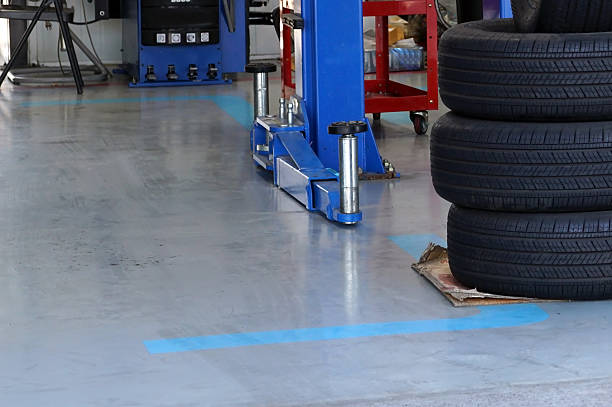
The trade-off between Shore hardness and compressive strength
Many people fall into a misconception when choosing floor coatings: they think “the harder, the better.” However, in the industrial flooring industry, a perfect balance between hardness and toughness is required.
1. The Truth About Shore Hardness
In technical specification sheets, you’ll often see the Shore D Hardness rating. For garage floor coatings, this determines the material’s resistance to indentations.
Low Shore D: is similar to rubber. If the coating is too soft, it will permanently dent when the steel wheel of a jack is applied. Although it will not crack, the ground will become pitted and uneven.
Extremely High Shore D: Similar to glass or some inferior ceramic tiles. While the surface is indestructible, it lacks elasticity at the microscopic level.
High-quality industrial-grade coatings typically maintain a Shore D hardness between 70 and 85. This means it is hard enough to withstand heavy rolling loads, yet retains minimal elasticity to prevent brittle fracture under extreme pressure.
2. Compressive Strength
The compressive strength of ordinary concrete is approximately between 3,000 and 4,000 psi. In contrast, a top-of-the-line heavy-duty garage floor coating system (typically 100% solids epoxy or polyaspartic acid ester) typically has a compressive strength exceeding 10,000 psi.
What does this mean? It means that if you choose the right system, the coating itself is stronger than the concrete underneath. If a failure occurs, it’s usually the concrete substrate that crumbles internally first, rather than the coating itself being crushed.
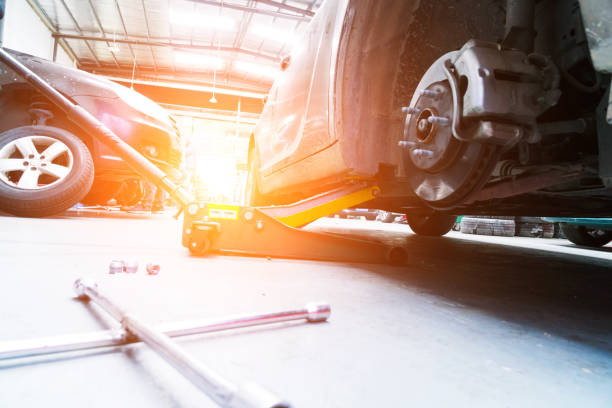
When Jack Stands meet epoxy flooring
Let’s move on to the harshest reality: Jack stands on the epoxy floor.
This is a classic example of a “point loading” problem. Imagine a 2-ton car mounted on four supports. Each support may only have a few square inches of contact area with the ground, or, in the case of older supports, the contact surface might simply be a sharp metal edge. In this case, the pressure is astonishing.
Why do tiles and regular paint fail?
- Tiles: Even so-called garage-specific tiles are prone to brittle breakage if a perfect mortar layer is not laid, especially when subjected to the impact of a jack being dropped or extremely high point loads.
- DIY water-based paint: These inexpensive kits available in supermarkets produce extremely thin films (typically only 2-3 mils). When pressure is applied to the epoxy floor using jack stands and slight lateral movement occurs, the paint film will delaminate directly from the concrete because its bond strength fails the shear test.
High-performance coating coping mechanisms
Professional coating systems address this issue through “cross-linking density.” High-quality polymer molecular chains intertwine tightly to form a unified armor. This is useful when using heavy-duty jacks:
- Pressure Dispersion: A coating of appropriate thickness (usually 10-20 mils or more) can act as a buffer layer, microscopically dispersing the pressure of point loads over a wider area of concrete.
- Shear resistance: The high-quality coating penetrates into the pores of the concrete, forming a mechanical interlock. Even when the jack wheel twists under load, the coating will firmly grip the substrate and will never peel off.
Impact test: the moment the wrench is dropped
Besides heavy loads, impact-resistant flooring is another key concern for mechanics. Imagine a heavy 19 mm ratchet wrench or brake disc slipping from a height of half a meter.
If it’s originally exposed concrete, a small corner might chip off, causing dust to accumulate. If it’s tile, it might crack open.
This is why the best flooring for mechanics is often not the hardest material but rather the most “tough” material. Here, we introduce a key concept: elongation at break.
- Brittle materials (such as ordinary epoxy) have low elongation and are easily broken by impact.
- Elastic modified materials (such as polyurea/polyaspartic acid esters): These advanced materials have better elongation. When a wrench is thrown to the ground, the coating undergoes a tiny deformation to absorb kinetic energy and then quickly returns to its original shape.
This “softness overcomes hardness” property ensures that the floor remains intact even after years of heavy tool abuse. It not only protects the floor but also your tools—the probability of a tool being damaged when dropped on the resilient coating is far lower than when dropped on hard tile or concrete.
The Ultimate Guide to Choosing a Mechanic
If you frequently perform maintenance work in your garage, please pay attention to the following three aspects when choosing garage floor coating:
1. Avoid DIY kits
polyurea/polyaspartic polyurea/polyasparticCommercially available waterborne epoxy resins with 50% solids content cannot provide sufficient thickness to cushion the pressure of a jack. What you need is 100% solids epoxy as a primer or a complete Polyurea/Polyaspartic system.
2. Pay attention to thickness
For heavy-duty garage floor coatings, thickness is key. A standard industrial-grade flooring system should have a total thickness of at least 15-20 mils. A coating that is too thin is like putting a layer of cling film on a concrete floor; it simply won’t pass the jack stands on epoxy floor test.
3. The balance between slip resistance and cleanliness
As a mechanic, oil leaks are a common occurrence. You need a dense, non-porous surface to prevent oil from penetrating. At the same time, for safe operation of heavy machinery, the surface needs to have an appropriate amount of anti-slip aggregates added to ensure your feet don’t slip when tightening screws.
Industry Insight: There is no single “magic potion.” The strongest systems are usually complex: a highly penetrating primer locks in the concrete, a high-strength intermediate coat provides thickness and compressive strength, and a highly abrasion-resistant, chemically resistant topcoat protects against brake fluid and gasoline corrosion.
Conclusion
In your garage, the floor is your most loyal companion, silently bearing tons of weight and countless impacts. While no floor is absolutely “indestructible,” by understanding Shore hardness, compressive strength, and material toughness, you can filter out truly impact-resistant flooring.
The next time you lift the jack to replace the suspension system, you should feel at ease—because you know that the garage floor coating beneath your feet is technologically advanced enough to withstand heavy pressure, just like you.
FAQ (Frequently Asked Questions)
Q1: When using jack stands on garage floor coating, are additional pads required?
scratches. While a high-quality industrial-grade coating can certainly withstand the direct pressure of jack stands on an epoxy floor, as best practice, we still recommend placing a thin plywood or rubber pad under the supports. This is not only to protect the coated surface from scratches but also to distribute extreme point loads and protect the underlying concrete substrate from microcracks.
Q2: For heavy mechanics, which is better, polyaspartic acid or epoxy?
Both have their advantages, but combining them yields the best results. Epoxy resins typically possess extremely high adhesion and compressive strength, making them suitable for load-bearing applications as primers and intermediate coats. Polyaspartic acid esters, on the other hand, offer exceptional abrasion and impact resistance and are UV resistant and do not yellow, making them an ideal topcoat choice for mechanics‘ flooring. Fully polyaspartic acid ester systems are also feasible, offering faster curing and better toughness.
Q3: If I accidentally drop a heavy object on the ground, causing dents or fragments, can this heavy-duty coating repair them?
Yes. This is precisely where heavy-duty garage floor coating is superior to tiles. If tiles break, you need to chisel off the entire piece and replace it. With resin coating, you usually only need to sand the damaged area, apply a small amount of repair material, and seal the area; the repair marks are often difficult to detect.


