The Science of Slip Resistance in Garage Floor Coating: Safety Is More Than Just Added Value

Many people perceive garage floor coatings as simply a way to make the garage look neater and more polished. However, those who truly understand the core technology know that safety, especially its anti-slip performance, is the most underrated aspect of the entire system design. A high-quality anti-slip floor not only impacts appearance but also the long-term safety of homes and workplaces. After all, slippery surfaces are silent risk amplifiers, and excellent coating science is the technical barrier that prevents such risks.
Table of Contents
The Science of Friction Coefficient: The Invisible “Safety Parameter”
Any discussion of anti-slip performance hinges on a core metric: the coefficient of friction (COF). This seemingly technical term actually determines your stability when walking on the ground, pushing a heavy object, or turning a wheel.
According to ASTM D2047, a surface is considered “slip-resistant” when its static coefficient of friction (SCOF) is greater than 0.5. However, in practice, the target for garage floor coatings is typically higher: a coefficient of friction of 0.6 or above to maintain stable grip in complex environments such as oil, moisture, and dust.
Modern high-end coatings often increase the coefficient of friction in three ways:
- Surface texture microstructure: Increase contact surface friction through micron-level roughness design.
- Anti-slip particle additions, such as silica sand, aluminum oxide, or polymer microbeads, embedded in the coating surface.
- Material self-wetting regulation: technology for regulating the surface energy of polymer materials to make them stable in a humid state.
This is not a chemical game that can be completed by simply “sprinkling some sand,” but a surface engineering that takes into account both mechanics and aesthetics.
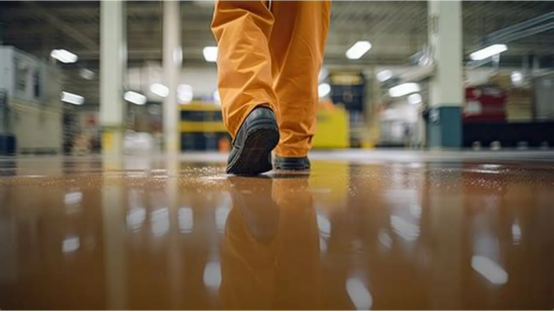
Diverse choices of anti-slip particles: not only materials, but also strategies
While most users only notice the “gloss” of the floor, designers focus on the “resistance behind the touch.” The anti-slip particles added to garage floor coatings actually have a very sophisticated layered structure. The different particle materials, particle sizes, and mixing ratios determine their applicability and lifespan.
- Silica Sand: The most common and low-cost, but it is easily worn flat under long-term friction and is suitable for low-traffic areas in homes.
- Aluminum Oxide Grit: Extremely hard, it’s often used in industrial garages or repair shops. It maintains its anti-slip properties even under heavy vehicle traffic.
- Polybeads: Suitable for users who want to balance anti-slip and aesthetics. The particles are transparent, lightweight, and will not destroy the overall color of the floor.
- Crushed Glass: An environmentally friendly choice, with sharp and reflective grains that enhance nighttime visibility.
More advanced coatings utilize a “particle gradient design”—a mix of coarse particles at the bottom for increased grip and fine particles at the top for a smoother feel. This design, which combines stability with comfort, has become a recent trend in garage floor coatings.
Surface texture design: the boundary between mechanics and aesthetics
If the anti-slip particles are the “skeleton,” then the surface texture is the “skin.” Excellent garage floor coatings no longer pursue a perfectly smooth mirror finish but instead achieve a balance of safety and design through a controlled texture structure.
There are currently three main texturing strategies:
- Micro-Texture: Creates friction through microscopic bumps and depressions, commonly seen in residential and light commercial spaces.
- Stamped Pattern: Stencil printing technology makes the surface both decorative and water-repellent.
- Hybrid Pattern: Locally deepen the texture in key areas (such as entrances and exits or ramps) instead of covering the entire area, improving safety while maintaining overall aesthetics.
Particularly noteworthy is the introduction of “intelligent surface self-healing” technology by some coating brands. When the coating becomes slightly worn due to friction, the polymer molecular chains rearrange themselves in a thermal environment, automatically restoring their original anti-slip properties. This significantly extends the lifespan of the garage floor coating and makes maintenance much easier.
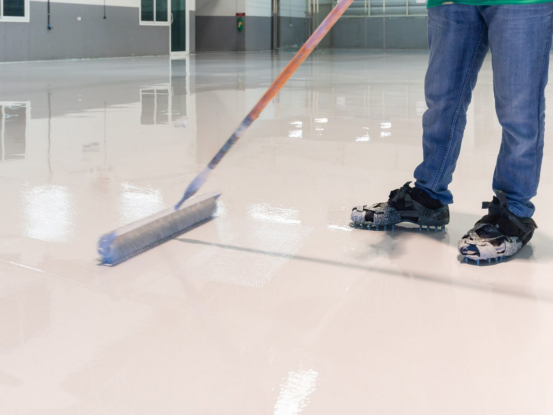
Combination of laboratory data and real experience
While laboratory testing is certainly accurate, true anti-slip performance depends on field performance. For example, in the North American market, consumers generally refer to two types of data when choosing garage floor coatings:
- ASTM D2047 Static Friction Coefficient Test
- ASTM C1028 Dynamic Friction Coefficient Test
However, professional testing doesn’t always replicate reality. For example, a Michigan user found that despite testing showing a COF of 0.65, the surface became slippery and icy during winter, significantly reducing its effectiveness. He subsequently switched to a hybrid coating containing polymer microbeads, which actually resulted in even better grip.
This also reveals an important fact—anti-slip science is not a “once and for all” parameter but a dynamic balance that needs to be considered in combination with the use environment, temperature and humidity changes, and surface wear.
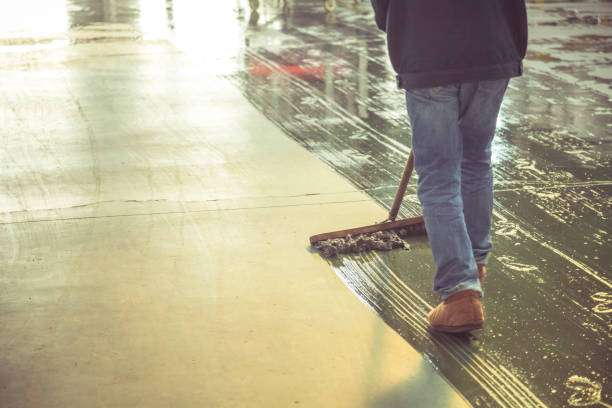
Maintenance strategy: keep anti-slip as good as new
Even the strongest coatings can’t withstand the ravages of time and tires. If you want your garage floor coating to maintain its anti-slip properties over the long term, regular maintenance is essential.
Key recommendations include:
- Use pH-neutral detergent to avoid acid and alkali damage to the particle surface.
- Reapply a thin coat of protective film every 12–18 months to repair micro-wear.
- In areas with frequent foot traffic or vehicle parking, a local reinforcement coating strategy can be adopted.
Interestingly, the latest nano-coating technology is changing this maintenance paradigm. Some manufacturers have introduced “self-cleaning coating” systems that exploit surface energy differences to prevent stains from adhering, reducing the risk of slipping while also slowing down aging. This transforms anti-slip technology from a “passive maintenance” approach to an “active safeguard.”
Future trends: from physical anti-slip to intelligent sensing
The next step in anti-slip science may extend beyond “grains” or “textures.” In the wave of smart building materials development, garage floor coatings are beginning to incorporate sensor technology. When surface moisture or oil concentration exceeds standards, the system prompts the user to clean via light signals or mobile apps. These products are already in use in some high-end garages and laboratory spaces in Europe and the United States, gradually establishing a new direction for “smart and safe flooring.”
Conclusion
Anti-slip performance is not just an added value but one of the core competitive advantages of garage floor coatings. It represents a complete scientific system of friction, materials, and structural design—serving both safety and aesthetics.
When you walk into a bright garage again, try to pay attention to the subtle resistance under your feet. That’s not accidental friction, but a sense of security created by technology and design.


