From Basic to Advanced: A Complete Analysis of Five Surface Treatment Methods for Garage Floor Coating

Between industrial and domestic spaces, garage floors often face the greatest test of durability. Unlike interior flooring, which is primarily decorative, garage floor coatings emphasize a balance between adhesion and impact resistance. However, an often overlooked fact is that even the most high-performance coating will significantly reduce its lifespan if the base layer isn’t properly prepared. The real key lies not in the coating itself, but in the invisible preparation.
This article systematically analyzes the five most common and effective floor prep methods: mechanical grinding, sandblasting, acid etching, vacuum sanding, and wet sanding. From physical structure to chemical reaction, from surface roughness to micropore density, each method directly determines the adhesion, wear resistance, and service life of the garage floor coating.
Table of Contents
Mechanical grinding: Let concrete “breathe again.”
Mechanical grinding is almost the industry standard among all pretreatment methods. Using a grinding machine with a diamond grinding wheel, it can precisely remove the surface contamination layer, old paint film, or loose cement paste, restoring the open capillary structure of the concrete surface.
The advantage of this method is that grinding not only cleans but also “regenerates.” At the microscopic level, it re-exposes the ground pores, providing ample embedding points for subsequent coatings, thereby significantly improving the mechanical adhesion of the garage floor coating.
Professional construction teams typically select abrasive discs of varying grit sizes based on the hardness and contamination level of the floor, gradually transitioning from coarse to fine grinding. The correct sequence not only affects surface smoothness but also controls coating thickness. Over-grinding can create enlarged pores, leading to material waste; under-grinding can compromise permeability.
In short: Mechanical grinding allows concrete floors to regain their “adsorption capacity” and is the cornerstone of a durable garage coating.
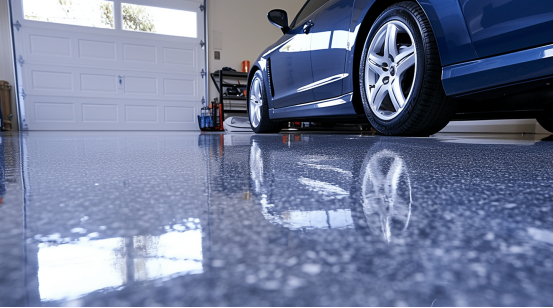
Sandblasting: Efficient cleaning and roughening in parallel
If grinding is “carving,” sandblasting is more like “blasting”—using high-speed jets of steel sand or mineral sand to impact the surface, removing old layers and oil stains while forming microscopic bumps and grooves on the ground.
The advantages of sandblasting lie in efficiency and uniformity. It can quickly treat large areas while achieving the desired roughness (typically CSP grades 3–5). This surface texture effectively increases the adhesion area for epoxy or polyurethane coatings, making the garage floor coating more resistant to pressure and peeling.
However, sandblasting isn’t a panacea. Dust control and noise levels are crucial considerations for confined spaces or residential garages. Some professional teams utilize “enclosed recycling sandblasters” to maintain efficiency while minimizing secondary pollution.
With the improvement of equipment technology, some construction parties have begun to add a light grinding process after sandblasting to achieve a balance between surface roughness and flatness—this has become the “hidden standard” of high-end garage floors.
Acid etching: opening pores through chemical reaction
Acid etching is a representative chemical treatment method. Its principle is simple and precise: diluted hydrochloric acid or phosphoric acid reacts with the calcium carbonate in the concrete, dissolving alkaline impurities on the surface and simultaneously creating micropores that allow the coating to be “embedded.”
The advantage of acid etching is that it penetrates deeper into the surface structure, making it easier to reach corners and edges than mechanical grinding, making it particularly effective for lightly contaminated floors. Furthermore, the pores formed by acid etching are uniform and finely distributed, significantly improving the permeability of the garage floor coating.
However, this technology also places higher demands on the professionalism of the applicator. Acid concentration, reaction time, and thoroughness of residual acid removal—failure in any of these steps can lead to inadequate neutralization or alkaline resurgence, compromising coating stability.
Therefore, in modern construction standards, acid etching is often used as an auxiliary process in combination with other methods (such as sandblasting or grinding). It is like a “precision fine-tuning” to make the surface condition more balanced.
Vacuum polishing system: an extra layer of assurance for cleanliness
High-end garage floor coatings increasingly emphasize cleanliness, and vacuum sanding systems are designed for this purpose. They utilize a simultaneous vacuuming and sanding mechanism, instantly recovering dust particles during sanding to maintain a dust-free construction environment.
This method is not only environmentally friendly but also provides a hidden guarantee for adhesion. Dust particles left on the surface can form a “barrier layer,” causing voids in the coating’s microstructure and reducing bond strength. Vacuum sanding effectively avoids this problem.
More notably, modern vacuum sanding equipment can also monitor floor smoothness, temperature, and humidity in real time, providing data reference for subsequent coating applications. This “data-driven preparation” has become a new trend in smart construction and also makes the quality of garage floor coatings more traceable.
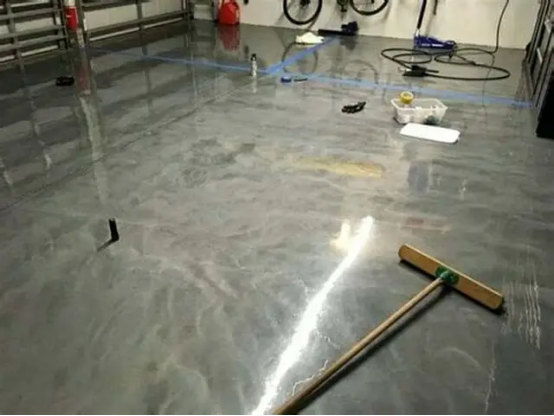
Wet grinding systems: a new trend towards gentle yet efficient processing
More and more construction teams are turning to wet grinding—adding a small amount of cooling water during the grinding process to reduce dust and prevent overheating of the concrete surface. This method is particularly suitable for porous or old floors because it reduces the risk of surface chipping.
The subtle advantage of wet sanding is that it preserves rather than destroys the structure. The concrete surface avoids the microcracks that dry sanding can create, maintaining a higher overall density. In this state, the garage floor coating adheres more evenly and creates a smoother, mirror-like finish.
However, the wet-sanded floor must be completely dry before coating. Otherwise, residual moisture may cause blistering or delamination. Applicators often use infrared detectors to ensure that the moisture content meets the standard before proceeding to the next step.
Collaboration and selection strategies for different processing methods
In real-world projects, a single method often isn’t enough to handle complex situations. For example, for floors with oil stains, old coatings, and structural cracks, a combination of sandblasting, acid etching, and vacuum polishing is often used to maximize adhesion and minimize defects.
The construction team selects the optimal combination based on the garage floor’s strength grade, the operating environment (such as temperature, humidity, and vehicle load frequency), and the target coating type. This customized base treatment strategy is the core competitiveness of high-quality garage floor coating.
If the coating is the “protective film,” then ground pretreatment is the “foundation engineering”—it determines the stability of the entire system. Any attempt to skip this step is like “burying mines under the perfect surface.”
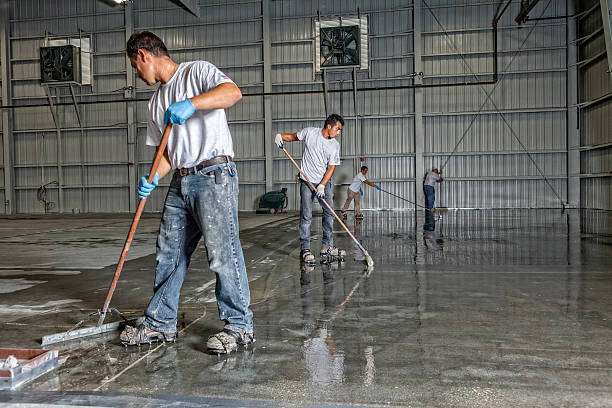
Future trends: intelligent detection and nano-pretreatment
As technology advances, the flooring industry is also quietly evolving. Some brands have begun to introduce nanoscale surface pretreatment agents, which can increase the polarity of the concrete surface without damaging the structure, thereby enhancing chemical bonding.
The integration of an AI image recognition system and moisture detection technology has shifted the construction process from relying solely on experience to relying on data. By monitoring pore distribution and coating permeability in real time, construction workers can more precisely control the adhesion conditions of the garage floor coating, achieving quantifiable quality assurance.
Conclusion
The success of floor coatings is never the result of a single bucket of paint, but rather the triumph of underlying logic. Five surface treatment methods, ranging from physical to chemical and from manual to intelligent, each play a distinct role—together, they contribute to a high-performance, long-lasting garage floor coating system.
True professionalism lies not in the pursuit of the fastest construction speed, but in respecting every “invisible process,” because only a carefully polished floor is worthy of a coating that will stand the test of time.


