
Many garage cleaning problems aren’t due to a lack of diligence but rather a high-consumption maintenance cycle from the outset.
Floors appear clean, only to quickly re-accumulate dust; oil stains are repeatedly wiped away, yet dark marks remain; Even immediately after cleaning, shoes and tires bring fine particles back into the space.
Over time, cleaning becomes a continuous but largely ineffective task.
It is against this backdrop that the discussion about garage floor coating has begun to shift from whether it looks good to a more practical question: does it really change the way and frequency of cleaning, thereby reducing long-term maintenance costs?
To answer this question, we cannot simply look at whether cleaning has “decreased,” but rather we must look at whether the act of cleaning itself has undergone a structural change.
Frequent cleaning before coating is often an unavoidable choice.
The reason why cleaning frequency is so high on untreated or aged concrete floors is often not because of excessive use, but because the floor itself is constantly generating “new dirt.”
The porous structure of concrete makes it easy for dust, tire residue, oil, and moisture to be absorbed into the surface.
Over time, problems such as surface sanding and fine peeling gradually appear.
These particles, which are not easily visible to the naked eye, are the main source of repeated dust accumulation in garages.
In this state, common cleaning methods typically include:
- Frequent sweeping
- Repeated mopping
- Use of stronger cleaning agents
However, the problem is that these actions do not prevent the formation of new contaminants; on the contrary, they may accelerate surface wear, further increasing the need for cleaning.
From the perspective of garage floor maintenance, this is a typical “passive maintenance” model: cleaning is not for maintaining condition but for chasing the ever-deteriorating surface conditions.
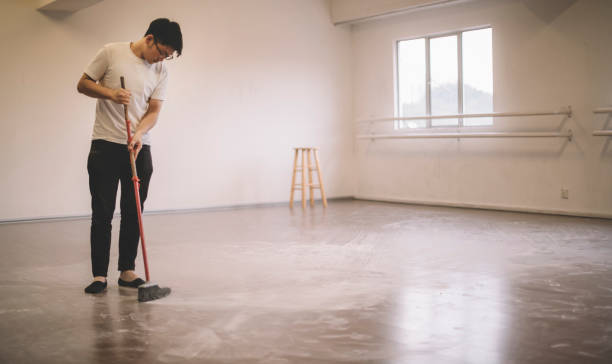
How Garage Floor Coating Changes the Generation Logic of “Dirty”
Once Garage Floor Coating forms a continuous, closed surface, the most noticeable change is not that the floor immediately becomes spotless, but rather that the source of dirt is redefined.
The sealed floor no longer releases concrete dust, nor does it allow liquids and grease to penetrate the structure.
Dirt and grime begin to remain more on the surface rather than “growing” within the floor.
This seemingly subtle change directly impacts the effectiveness of cleaning efforts.
A recurring feedback from many users is that cleaning has become more “results-oriented.”
The same sweeping or wiping is no longer just a temporary surface cleanup but truly reduces the amount of buildup before the next cleaning session.
This is one of the reasons why easy-clean garage floor coating is frequently mentioned.
The term “easy-clean” does not mean that cleaning is completely unnecessary, but rather that cleaning itself is no longer a laborious process.
Changes in cleaning methods often appear earlier than changes in frequency.
In actual use, the decrease in cleaning frequency usually does not happen immediately.
What happens earlier is the change in cleaning methods.
Before the coating, many garages had to deal with dust, oil stains, and moisture all at once, so cleaning was often a mixed operation, requiring sweeping, mopping, and sometimes repeatedly treating the same area.
After the surface is sealed, cleaning gradually evolves into a simpler and more predictable process.
For example:
- A single wet mop or spot cleaning is often enough to restore the floor to its original condition.
- Oil stains no longer spread rapidly.
- Dust no longer embeds itself deep in the texture.
This change does not immediately reduce the number of cleaning sessions, but it significantly reduces the time and effort required for each cleaning.
In the long run, the core cost of garage floor maintenance is not just “how often to clean,” but “how much to pay for each cleaning.”
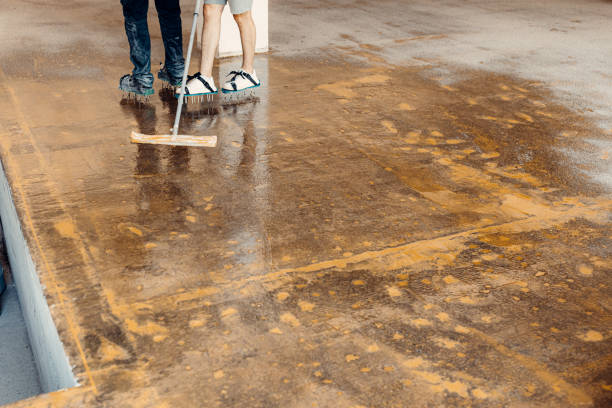
Whether the cleaning frequency has actually decreased depends on the usage scenario.
It is worth emphasizing that the impact of Garage Floor Coating on cleaning frequency is not consistent in all scenarios.
In family garages, which are primarily used for parking and have low entry and exit frequency, cleaning cycles tend to be longer because the floors no longer continuously accumulate dust.
In work or multi-functional garages, the cleaning frequency may not decrease significantly, but the perceived burden of cleaning is noticeably lighter.
For example, spaces where DIY activities or equipment operation are frequently performed still require regular cleaning, but the dirt is more concentrated and easier to remove, preventing long-term residue buildup.
This difference illustrates that cleaning frequency is not the only metric; controllability in cleaning is equally important.
If we extract commonalities from user discussions about easy-clean garage floor coating, we can find a pattern:
- Whether cleaning is reduced depends on the intensity of use.
- But whether cleaning is easier is not a universal experience.
Long-term maintenance costs are often underestimated in terms of the “time” dimension.
When assessing the cost of garage floor maintenance, many people tend to focus only on the cost of cleaning products, tools, or occasional deep cleaning but overlook a more hidden factor—time.
Frequent and inefficient cleaning continuously consumes users’ time and energy, and this consumption is difficult to quantify but is real.
By sealing the surface, even if the cleaning frequency is only slightly reduced, the accumulated time savings in the long run are considerable.
Some users only realized after using the service for a while that they no longer needed to “plan” time for garage cleaning but could instead complete maintenance at more flexible times.
This change is not reflected in the book costs, but it directly impacts the user experience.
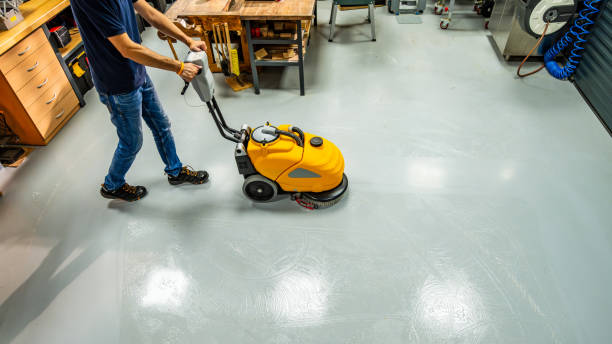
When cleaning is no longer a struggle, the way we use space will also change.
One often overlooked phenomenon is that as the cleaning burden decreases, people’s attitudes toward using garage space also change.
Areas that were once considered “only for parking” are now being used for storage, exercise, or simple work.
Tools no longer require repeated dusting.
The floor condition is more stable, increasing the predictability of the space.
These changes are not directly triggered by garage floor coating but are closely related to improvements in cleaning frequency and the cleaning experience.
In this context, cleaning is no longer a limiting factor in space use but rather a routine action to maintain the condition of the space.
Whether cleaning needs to be reduced depends on whether “dirt is controllable.”
Garage floor coating doesn’t make cleaning completely disappear, nor does it mean your garage can be left unattended indefinitely.
What it truly changes is how dirt is generated and the return on investment for cleaning.
When the floor stops creating new problems, there’s room to reduce cleaning frequency; even if the frequency remains the same, cleaning itself becomes easier and more predictable.
From a long-term perspective of garage floor maintenance, this change is often more important than simply “reducing the number of cleaning sessions.”
Perhaps the question worth asking is
What we’ve been frequently cleaning in the past, was it the ground itself or the problems that the ground has been constantly exposing?


