
Table of Contents
If you’re staring at that worm-like crack in your garage floor, thinking, “Just apply a thick coat of garage floor coating, and all this ugliness will disappear, and the floor will be indestructible.”
Please stop reaching for your wallet immediately.
I’ve seen too many tragedies like this: homeowners spend thousands of dollars, excitedly looking at their new, gleaming floors.
But less than six months later, when a car drives over a certain spot, they hear that crisp “crack”—the coating peels off in large pieces like sunburnt dead skin, revealing the still damp, cracked concrete underneath.
At that moment, what peels off is not just the coating but also your “IQ tax.”
The advertisements in the market have misled you. They make you think that garage floor coating is the savior of concrete, a structural reinforcement.
But today I’m going to tell you a truth that the industry is reluctant to admit: the coating is just skin, not bones. If your foundation is bad, even the most expensive cosmetics are just covering up the problem.
Today we’ll talk about the limitations of garage floor coating and see which problems it absolutely cannot solve.
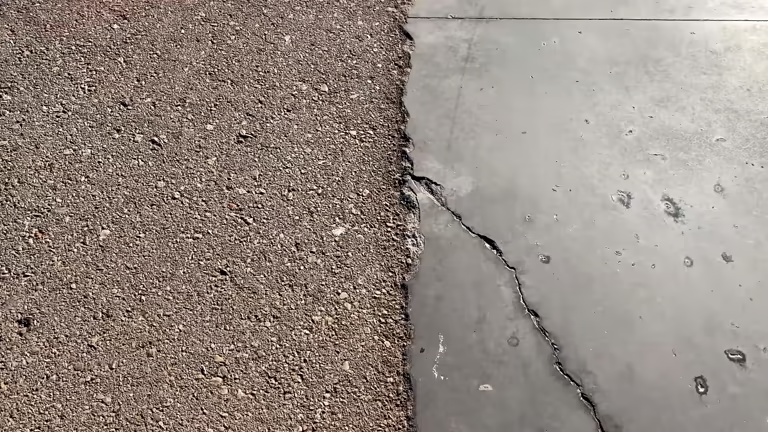
The lie of a crack: it can be filled, but it can’t hold back a “living” wound.
Many DIY kits include a tube of putty and tell you to “fill the cracks, paint it, and it will look brand new.”
This is practically a crime.
You need to distinguish between two types of cracks: “dead cracks” and “live cracks.”
Hairline cracks, caused by the natural shrinkage of concrete during curing, can indeed be perfectly covered by garage floor coating.
However, structural cracks—wide cracks caused by foundation settlement or slab movement—are beyond the coating’s capabilities.
Here’s a simple physical logic: while most epoxy or polyurea coatings have a certain degree of flexibility, their tensile strength is limited.
As the soil beneath the garage expands during the rainy season and contracts during the dry season, the concrete slabs will experience slight displacement.
This displacement might not be felt under your feet, but for the coating attached to the surface, it’s like a devastating earthquake.
If you don’t first seal these “live cracks” by using stitching or injecting structural adhesive and instead apply a coating directly, even the top-quality industrial paint with 100% solids content will tear back along the original cracks within a few months.
This phenomenon is called “telegraphing.”
It’s like putting on a bandage before the wound has healed. When the wound bursts open, the bandage is not only useless, but it will also tear off the skin and flesh along with it.
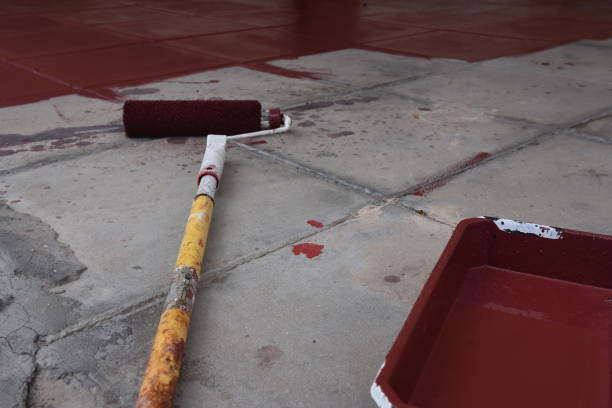
The Invisible Killer: The Lifting Force of Groundwater Vapor
This is garage floor coating’s biggest weakness and the culprit behind countless high-end projects failing.
You’re standing in your garage, and the floor seems pretty dry, right? But that’s just on the surface.
Concrete is essentially a giant, rigid sponge. If your house wasn’t built with a vapor barrier underneath the slab, or if you live in an area with a high water table, moisture will continuously seep upwards from the ground.
This leads to a terrifying physical phenomenon: hydrostatic pressure.
When you seal a layer of airtight garage floor coating on the surface, the rising moisture has nowhere to go and accumulates at the interface between the concrete and the coating.
As pressure builds up, it can generate an upward thrust of up to 30-40 PSI.
Do you know what the typical adhesion of a coating is? If handled properly, it’s around 300-400 PSI.
However, under continuous moisture erosion, alkaline substances on the concrete surface can be carried away, causing the adhesion to fail.
The end result is bubbling.
You’ll find large blisters on the ground, like burns. If you pop them, you’ll even find water inside.
This isn’t due to poor coating quality; it’s because you’ve violated the laws of physics.
Industry insider secrets revealed: Why do many contractors refuse to perform a humidity test? Because if the humidity level is found to be too high, an expensive moisture-mitigation primer is required, which doubles the price and scares away customers. So they choose to take a gamble, hoping that bubbling won’t occur before the warranty expires.
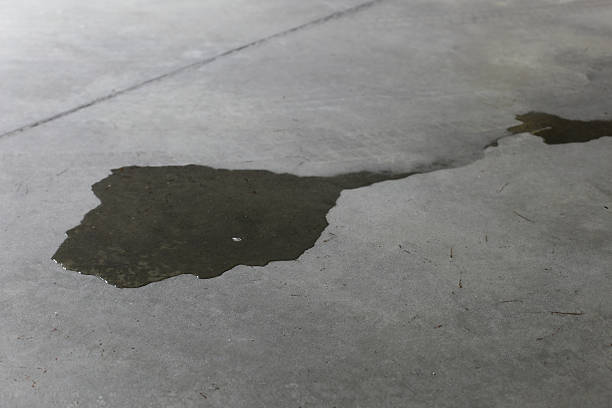
Oil stain penetration: a nightmare that cannot be “sealed”
If you’re a car repair enthusiast, or if your old car has been leaking oil for years, that dark area is a no-go zone for the coating.
Many people naively think, “I’ll just wash it twice with cleaning agent, then etch it with strong acid, and then paint it to cover up the oil stains, right?”
That’s too naive.
Engine oil can seep several centimeters deep into the capillaries of concrete.
When you apply garage floor coating, the oil inside the concrete slowly seeps upwards like a ghost.
Because oil is lighter than water and has extremely low surface tension, it breaks the chemical bonds between the resin and the concrete.
This can lead to a defect called “fish eye,” or the coating may peel off completely after a few months, leaving the back feeling greasy.
For heavily oiled surfaces, the following steps are necessary:
- High-temperature flame treatment
- Use of special oil-absorbing microbial cleaning agents
- In some cases, the contaminated concrete may need to be cut off and re-poured.
If the oil cannot be completely removed, no coating should remain on the surface for more than a year.
FAQ (Frequently Asked Questions)
Q1: Since the coating is susceptible to moisture, how can I tell if my garage is damp?
A: Conduct a simple “plastic sheet test.”
- Cut a 2×2-foot piece of clear plastic sheeting.
- Secure it tightly to the garage floor with strong tape.
- Wait 24-48 hours.
When you peel off the plastic sheeting, if you find the concrete has darkened (become damp), or if there are condensation droplets on the back of the plastic sheeting, it means your groundwater level is too high.
In this case, you absolutely cannot apply a regular garage floor coating; you must first apply a moisture-proof primer.
Q2: Since the coating cannot repair structural cracks, what should I do?
A: You must address the root cause first. For active structural cracks, you need to hire a professional concrete repair company to:
- Cut open the crack.
- Insert metal staples.
- Pour in high-strength epoxy mortar.
Only after all of this has completely cured and been sanded smooth is the floor ready for a coating. Remember, the coating is the final decorative step, not the initial reinforcement.
Q3: Why is my coating peeling off where the tires are parked?
A: This is what’s known as the “hot tire pickup,” but the root cause is often not the coating’s lack of heat resistance but rather improper substrate preparation.
For example, water-based epoxy commonly found in DIY kits, due to its low solids content, is inherently prone to being picked up by hot tires.
If professional garage floor coatings still peel off, it’s usually because the floor wasn’t properly cleaned of oil stains or wasn’t sanded rough enough, resulting in insufficient grip.
Conclusion
Garage floor coating is a great invention; it’s dustproof, durable, aesthetically pleasing, and can even increase property value.
But it’s definitely not magic.
It’s like an expensive suit. If you’re a fit bodybuilder (with a healthy, concrete base), wearing it will make you look incredibly handsome. But if you have bone deformities or festering skin (cracked, damp, oily), forcing yourself into this suit will only tear it and make you look even more ridiculous.
Understanding the limitations of garage floor coating is not meant to discourage you but to help you save money.
Before picking up a paint roller, crouch down and examine your floor like a doctor.
If you lack the necessary tools, investing in repairing the base is far more worthwhile than buying several cans of expensive paint. After all, a solid foundation is essential for a polished finish.


