
In many garages, water accumulation is never a sudden problem. It’s more like a series of minor, overlooked issues: water from a car wash slowly lingers in corners, water from shoes gets trapped in the rain and doesn’t dissipate quickly, and irregular watermarks remain on the floor after snowmelt in winter.
—isIt’s only when someone nearly slips and falls, or notices rust on the bottom of metal tools that people start to wonder – is there something wrong with the floor itself?
CouldWhen the topic extends to garage floor coatings, another question arises:
could the coating alter the original drainage system, making the water accumulation problem even worse?
bad andTo answer this question, we must temporarily move beyond the simplistic judgment of whether the coating is good or bad, and start from the more fundamental physical logic.
material butDrainage does not depend on the surface material, but on the slope and flow path.
surface”From an engineering perspective, the drainage capacity of a garage floor is never determined by “how it looks on the surface,” but is controlled by two core factors: the floor slope and the liquid flow path.
Standard residential garages are typically designed with a slight slope to allow water to flow naturally towards the doorway or drain. This slope is often so subtle that it is almost imperceptible visually, but it plays a crucial role in the flow of liquids.
pooling onThe problem is that after long-term use, the original concrete surface can become uneven due to wear, sanding, or localized repairs. These minor unevennesses are more likely than the material itself to disrupt water flow, creating a hidden risk for water pooling garage floors.
air.”Therefore, before discussing garage floor drainage coating, one premise must be made clear:
If the original slope has been destroyed, no surface treatment can “create drainage capacity out of thin air”.
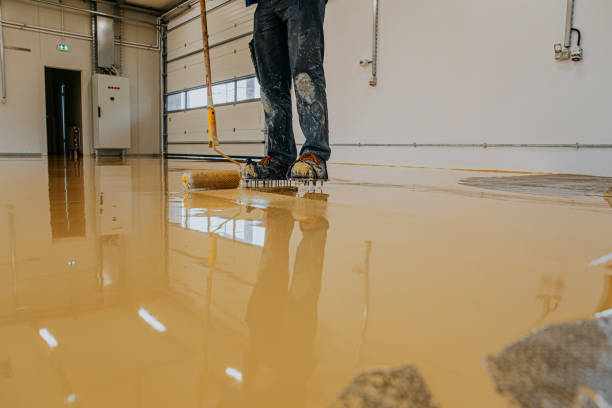
garage floor coatingWill the Garage Floor Coating alter the original slope structure?
about andThis is the point that many users are most concerned about, and also the point that is most easily misunderstood.
garage floor coatingsIn terms of material thickness, most Garage Floor Coatings have a film thickness far below that sufficient to substantially alter the slope. In other words, under normal application conditions, the coating itself does not smooth out or reshape the structural slope of the floor.
What we really need to be wary of is not the “coating cover,” but ignoring existing unevenness before application. If the ground already has low-lying areas, crack repair marks, or uneven wear, then the coating merely “fixes” these problems, rather than creating them.
In some user feedback, the so-called “more water accumulation after application” can often be traced back to structural problems that existed before construction. It’s just that the water retention becomes more obvious after the surface is uniformly sealed.
garage floor coatingThis is why, when discussing the impact of Garage Floor Coating on drainage, the industry typically emphasizes the importance of preliminary assessments rather than simply attributing the problem to the coating itself.
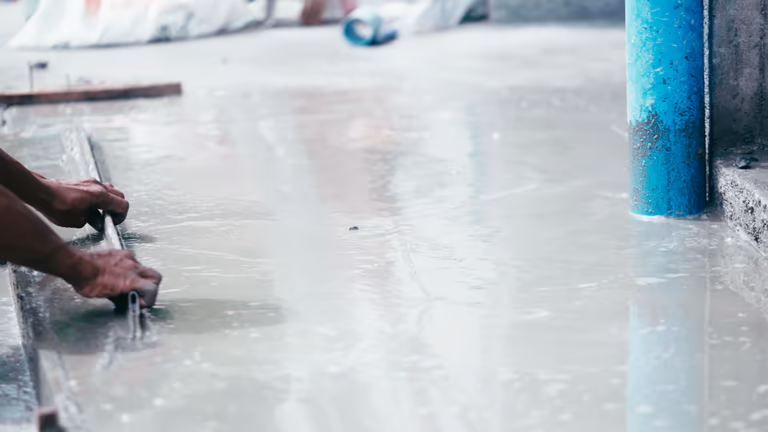
The subtle relationship between surface friction and liquid flow
Another often overlooked factor is the surface friction coefficient.
Untreated concrete surfaces, especially those in the sanding or aging stage, often have high microscopic roughness. This roughness increases the difficulty of cleaning, but it can also temporarily slow down the flow of water, making water accumulation appear less concentrated.
particles butOnce the garage floor coating forms a continuous, closed surface, the water flow path becomes more predictable. It is not absorbed by pores or interrupted by loose particles, but moves more directly down the slope.
capacity butFrom a physics perspective, this isn’t a decrease in drainage capacity, but rather a more honest behavior of water. Problems that were originally masked by surface defects are magnified and revealed after being sealed off.
In discussions about garage floor drainage coating, this “exposure” is often misunderstood as a negative change, but in reality, it provides a clearer basis for judgment in subsequent optimization.
Where is the real dividing line between water accumulation and the risk of slipping?
water.”The risk of slipping is not entirely the same as “whether there is water”.
More importantly, it depends on where the water is, how long it stays, and in what form it exists.
After the surface is sealed, the water tends to have clear boundaries and remain concentrated, rather than spreading randomly. This state is more visually noticeable and easier to clean up in a timely manner.
Conversely, on sandy or porous surfaces, moisture may be partially absorbed, creating a persistently damp area on the surface, which increases the hidden risks of slipping and mold growth.
coincidence butMany users have mentioned after using the coating for a period of time that although the ground appears more “wet” in the short term, the overall number of slippery accidents has actually decreased. This is not a coincidence, but is directly related to the fact that the behavior of water becomes more controllable.
The sensitivity to drainage varies depending on the usage scenario.
Not all garages face the problem of water accumulation in the same way.
- For families who frequently wash their cars, the ability of water to quickly leave the core activity area is a major concern.
- Tool or equipment storage garages are more sensitive to localized dampness.
- For spaces used for fitness or work, the requirements for slip resistance and dryness are even higher.
garage floor coatingIn these scenarios, Garage Floor Coating doesn’t “change the drainage logic,” but rather amplifies the question of whether the original design is reasonable. If the slope and drainage path are clear, a sealed surface often allows water to flow more directly; conversely, problems will surface earlier.
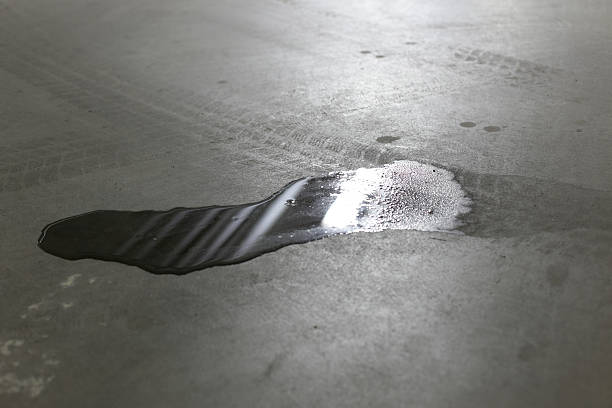
From “invisible dampness” to “manageable moisture”
garage floor coating.An interesting phenomenon is that many people only realize they’ve been enduring an “invisible dampness” after completing their Garage Floor Coating.
It wasn’t obvious water accumulation but rather long-standing dampness, muddy stains from a mixture of dust and water, and corners that were difficult to dry completely. Sealing the surface won’t automatically eliminate these problems, but it will make the presence of moisture more visible and predictable.
In real-world examples of water pooling on garage floors, this change is often the starting point for improvement, not the end point.
The coating won’t create problems, but it will make them more realistic.
Garage floor coating does not change the drainage logic of the garage floor; what it does is make the original slope design and flow path more directly apparent.
If the drainage system is properly designed, a sealed surface will only allow water to escape more quickly; if there are structural defects, the problems will be discovered sooner. This “visibility” is not a risk but a warning.
Perhaps the real question isn’t whether we should worry about the coating affecting drainage, but rather:
In a space that should have basic drainage capabilities, have we become accustomed to unreasonable water accumulation?


