Garage floor coating and anti-slip properties are not contradictory.

When many people first seriously consider garage flooring, they often come up with an almost binary choice: either a smooth, easy-to-clean surface or a rough, non-slip surface that always looks like a construction site.
This dichotomy isn’t entirely accurate.
In numerous real-world user discussions and industry case studies, a recurring question is, why do some garage floor coatings resemble ice while others remain firm in the rain? The answer lies not in whether or not they are coated, but in the coefficient of friction, surface structure, and our understanding of “safety.”
This article does not discuss purchasing or recommend specific products. Instead, it starts from the materials and physical logic themselves to break down how Garage Floor Coating finds a balance between “easy to clean” and “safe to walk on,” avoiding extreme choices.
Table of Contents
Anti-slip properties are not about roughness; what truly matters is the coefficient of friction.
In many non-professional discussions, “anti-slip” is often equated with “a rough enough surface.” However, in the fields of engineering and materials, the real indicator that determines safety is the coefficient of friction (COF).
Simply put, the coefficient of friction describes the ability of two surfaces to resist relative sliding when they are in contact.
For garage floors, the key factor isn’t “how rough it looks,” but rather:
- static friction coefficient in dry state
- Dynamic friction performance when wet, damp, or even oily
Industry data shows that when the ground is wet and slippery, if the coefficient of friction is below 0.4, pedestrian safety decreases significantly. This is why many “high-gloss” floors, while satisfactory when cleaning, can raise concerns when pushing carts or moving items in the rain.
It’s important to note that garage floor coatings do not inherently equate to low friction. The real problems often arise in the following scenarios:
- In pursuit of a mirror-like visual effect, the surface microstructure was sacrificed.
- After application, a continuous, dense, texture-free coating is formed.
- It ignores wet usage environments (car wash, rain, snow melting).
In other words, the danger does not come from the coating itself but from the “single-goal-oriented” design philosophy.
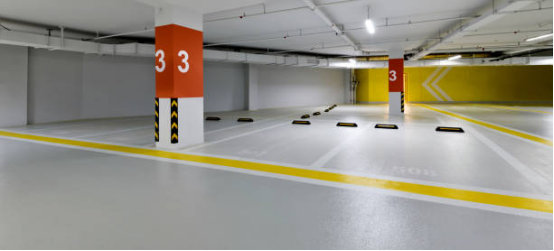
How surface structure affects both cleanliness and safety
If you look at a garage floor under a microscope, you’ll find that what determines the feel and slip resistance is not the particles visible to the naked eye, but rather a finer layer of surface structure.
From an industry perspective, the surface structure of garage floor coating can be roughly divided into three logics:
The first type is a completely smooth, enclosed structure.
The biggest advantage of this structure is its high cleaning efficiency. Dust, mud, and liquids don’t easily accumulate, and a mop or hose is sufficient for cleaning. However, its drawback is also obvious—once a water film forms, the contact between the sole and the ground quickly turns into slippery contact.
The second type is the large-particle, coarse structure.
This structure typically relies on visible particles or aggregates to create friction, providing an immediate anti-slip effect. However, in real-world use, problems gradually emerge:
Dirt easily gets embedded in the crevices, oil stains are difficult to remove completely, and cleaning time is endlessly prolonged. For home users, this often means “anti-slip, but unwilling to maintain it anymore.”
The third type, which has been discussed more in recent years, is the microstructure anti-slip logic.
This method does not rely on exaggerated graininess but rather improves wet friction performance through subtle undulations and evenly distributed surface textures without significantly increasing the difficulty of cleaning.
This is why some technical documents about non-slip garage floor coatings repeatedly emphasize the concept of “texture balance”—it’s not about being as coarse as possible, but about being “sufficient.”
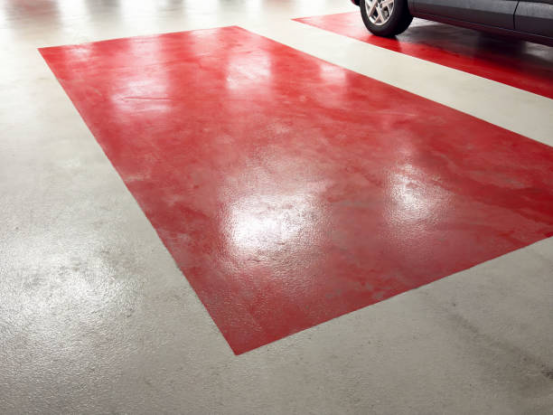
The real tug-of-war between easy cleaning and the safety of garage floor coating
In real user feedback, there is a recurring emotional point:
“I’m not looking for industrial-grade anti-slip; I just hope that when pushing a lawnmower or going in and out in the rain, I don’t have to subconsciously slow down every step.”
This statement actually pinpoints the core of garage floor coating safety—safety is not about extreme protection, but about whether the psychological burden in daily life is reduced.
If the surface is too rough, users will encounter these problems:
- The resistance to dragging the item increased significantly.
- The fine particles make walking barefoot uncomfortable
- Cleaning frequency forced to increase
However, if the surface is too slippery, another set of problems will arise:
- Shoe soles become noticeably slippery in the rain.
- A film of water forms on the ground after washing the car.
- Elderly people or children need to pay special attention when walking.
Therefore, the design logic of a truly mature garage floor coating is often not about “whether it is slip-resistant or not,” but about the slip-resistant properties in the usage scenarios.
For example, in parking areas, the tires themselves provide additional friction;
While in areas where people frequently walk and turn, microstructure anti-slip becomes more crucial.
This kind of zoning thinking has become a consensus in many professional construction discussions and engineering cases, but it is rarely clearly explained in general content.
Avoid extreme choices: Working backward from the usage scenario to derive surface strategies
A common misconception is trying to “do it all at once” during the design phase, compressing all requirements into one extreme specification.
However, in real-world use, a garage is not a laboratory but a highly mixed living space.
It may simultaneously undertake:
- daily traffic
- Simple repairs
- Car washing
- Storage and transportation
This is why more and more industry opinions emphasize that garage floor coating should be based on behavior, not parameters.
Instead of getting hung up on whether it’s absolutely slip-resistant, let’s go back to a few more practical questions:
- Does water or snowmelt frequently get in?
- How frequently do you walk?
- Is it used by elderly people or children?
- Does cleaning rely on high-frequency water washing?
When these questions are answered one by one, the conflict between “easy to clean” and “safe to walk on” will become clear and resolvable.
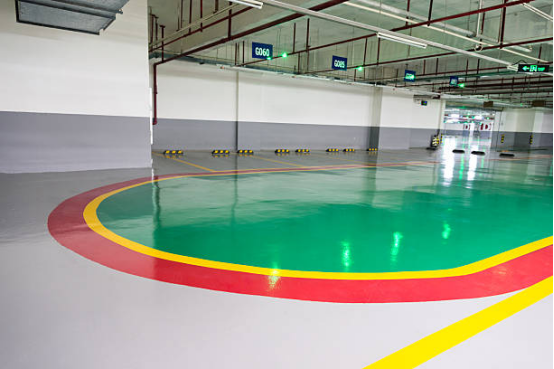
The overlooked detail: Wet friction is the real test
In many tests and user experience sharing, one detail is often underestimated—wet performance.
When dry, almost all surfaces “look safe.”
The real problem occurs in the few seconds after the car wash, when your rain boots have just stepped into the garage.
This is why technical documentation for non-slip garage floor coatings often distinguishes between dry COF and wet COF.
The former determines the feel underfoot, while the latter determines the probability of accidents.
From an experiential perspective, a truly mature solution is not one that makes the ground “grip,” but one that prevents the water film from forming a complete slip surface.
This capability comes precisely from the microstructure design mentioned earlier, rather than simply increasing roughness.
FAQ: Frequently Asked Questions about Garage Floor Coating and Slip Prevention
Does a garden floor coating always make a floor more slippery than a concrete floor?
Not necessarily. Exposed concrete itself has pores and texture, and while it offers good friction when dry, the risk of slipping is not low when it gets wet or oily. The key is not whether there is a coating, but how the coating treats the surface structure.
Will anti-slip treatments make cleaning much more difficult?
It depends on the anti-slip logic. While large-particle structures do tend to trap dirt and grime, a non-slip garage floor coating based on a microstructure, when properly designed, will not significantly increase the cleaning burden.
Is garage floor coating safety solely related to the material?
Not entirely. Usage habits, frequency of entry and exit, and humidity levels all affect the actual safety experience. The material is just a basic factor, not the only variable.
Why do some floors that weren’t slippery at first become dangerous over time?
Common reasons include surface wear, the formation of a film from cleaning agent residue, and dirt filling in the texture. This is why regular maintenance is repeatedly emphasized.
Anti-slip is not just a label but a result of the experience.
Returning to the initial question, is there a contradiction between garage floor coating and slip resistance?
Based on material logic and real-world user feedback, the answer is no.
The real contradiction often stems from our oversimplified understanding of “safety.”
When anti-slip is treated as an absolute label, extreme solutions are more likely to emerge;
While when it is seen as an experiential outcome that reduces psychological burden in specific scenarios, a balance is easier to achieve.
Perhaps next time you walk into a garage, pay attention to how your feet feel—
not whether they’re slippery, but whether you subconsciously slow down.
This moment often tells a more honest story than any other parameter.


